
So, I’m gonna talk about mothers.
My mother is dead. I watched her die nine days after I turned six. Then, *counts on fingers* november, december, january, february, march, april,*stops counting* Yeah, about six months later, I got a “wicked” stepmother. I recommended she read White Oleander by Janet Fitch after I read it when I was twenty. She once told me I caused her husband and her “anguish.” Her husband, who is on the offender registry. Her husband with whom I have TV static where my memories should be. Her husband, who was coddled by his mother so hard that she once told me not to push him to engage in any kind of emotional exploration. He’s just not good at those kinds of things, you see.
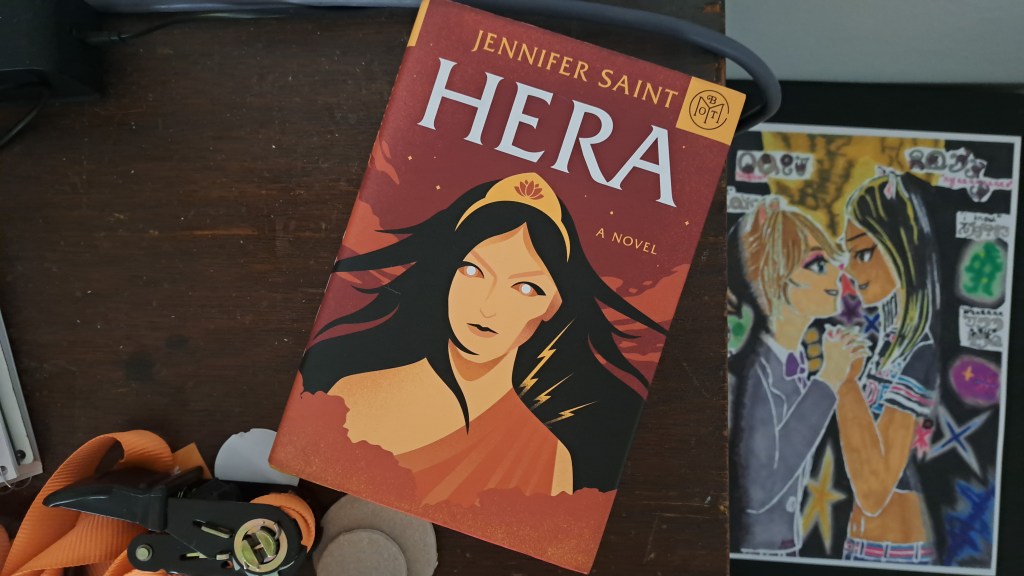
To be clear, I haven’t read Hera, yet. I was asked by a few friends to read it. And I’m gonna. I’m looking forward to it. I have a feeling I’m not going to resonate with the title character as much as I did with Circe from the book of the same name by Madeline Miller.
*queue bad Obama impression* Let me be clear, */impression* I get that being a parent is difficult. I was forced to be one for a few years. Mostly against my will. It was terrible for everyone involved. Never again. I made sure I couldn’t produce offspring, and it almost cost me my life.
When I think about mothers, and more particularly, mothers in media, I think my favorite is Sarah Connor from the TV show with her name (The Sarah Connor Chronicles). The basic premise of most Terminator stuff is that there’s a human guy named Kyle Reese and a robot guy played by Arnold Schwarzenegger sent to 1984 from the far flung future of 2029. Reese is a fighter with the human resistance against artificially intelligent machines, and the robot is from the opposing force (AKA Skynet). The robot guy is trying to 86 Sarah Connor to prevent her son, John Connor, from leading the resistance, but Reese gets KIA on his mission. And also fathers John Connor with Sarah Connor. Closed loop time paradox, bay-beeee~~~
In The Sarah Connor Chronicles, John responds the way any typical 15 year old would to being told, “You’re going to lead human kind in a war for survival against killer robots who are smarter, faster, and stronger than you in almost every perceivable capacity.”
John tells his mom that she’s got to stop it. Stop the war. That he’s not he is. That he’s not some messiah. The entire question would, of course, be moot if they didn’t have a resistance re-programmed T-888 named Allison from Palmdale Cameron played by Summer Glau, and John didn’t just survive a school shooting carried out by a substitute teacher in the year of their Lord 1999 with twenty of the people in the town stating that the shooter had “some kind of robot leg.”
All of this to say: Sarah Connor was right all along within the story of the Terminator world (if we accept the 1984 film, Judgment Day, and Chronicles as our storyline), and she was considered crazy and dangerous. Furthermore: when her son said he didn’t want to be future war leader John Connor, she accepted that. Not everyone around Sarah did, but she did. Which is kinda my point.
Just two months after I turned 17, I found myself at the MEPS station in Kansas City, MO.
TW: discussion of age-inappropriate relationships (context: literary analysis)
There are a few times when I’ve described myself as a tesseract. If Rachel Humphreys, Lou Reed’s muse, who is arguably responsible for re-shaping the face of rock music is a cube, then I feel the description is apt. In Detransition, Baby by Torrey Peters, the character of Reese points out that she could be a muse, but no one would want art in which the muse spoke for herself. I’ll come back to this.
One day in early summer 2023, I was sitting across the table from a cute cis boy who would later be inside me at Los Aguacates (he was in my bed in my bedroom when he was inside me). While we were still at the restaurant, he was telling me all about this novel series he wanted to write involving a war with space dragons that spanned a thousand years. I was on a kick of reading some dry-ass philosophy texts at the time, so I asked about Nietzsche, as “The Three Metamorphoses” from Thus Spake Zarathustra came to mind. The boy (26 to my 37) had no idea who Nietzsche was! Maybe I’m a weirdo, but I at least knew of Nietzsche by the time I was 19 (not from college). I was surprised, but I couldn’t mind because he was gentlemanly enough to cover dinner and the sex was incredible.
Someone I used to know writes stories that span millennia, I think. I say “used to know” because she’d ask for a bunch of free labor and then got mad because I told her I didn’t like it that her friend fantasized about my death at her birthday party. Then she apologized to me about seating arrangements and that I was at the party at all. I don’t know if she’s self-published or if she has a proper publisher (Yes, I am making that distinction this one time as someone who just puts stuff on her own website because. I am. THAT BITCH).

i. am. that. bitch.
Recently, I finished the fourth in a five book series called Soul Rider by Jack L. Chalker, which takes place over the course of centuries. Similarly, Circe by Madeline Miller takes place over the course of either centuries or millennia. I mention these because they are books that I’ve had personal contact with. I could bring up the Tolkien fantasy series, but that feels almost like cheating for the point I’m trying to make (and possibly isn’t even relevant…? I don’t know, fuck Tolkien, I’m tired of Tolkien, why are we still talking about Tolkien?!).
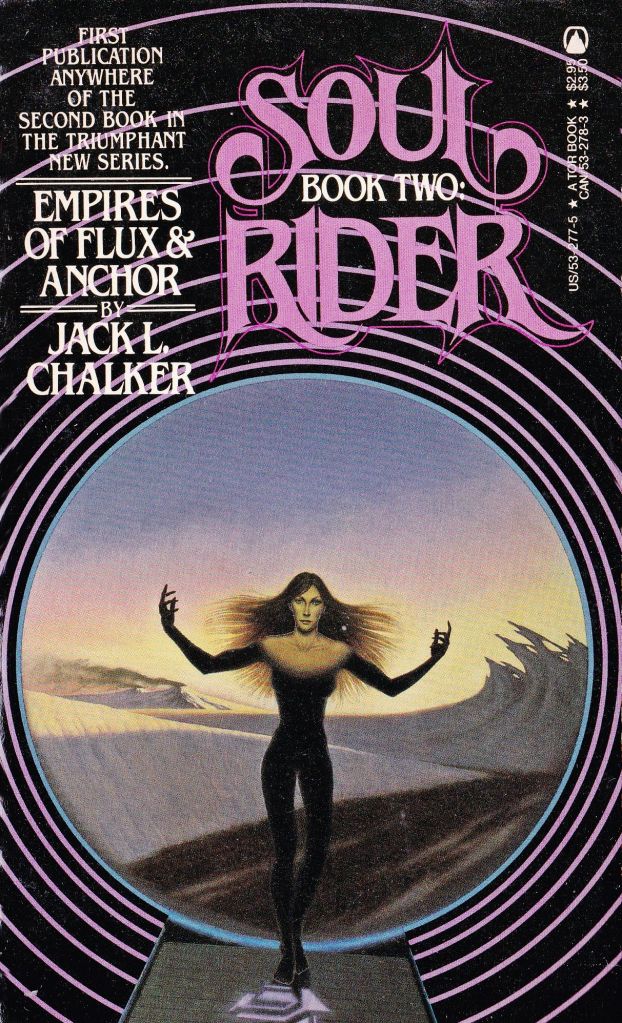
(k but for real tho this book cover is kinda iconic)
Another series I recently finished (again) was Cixin Liu’s Remembrance of Earth’s Past, more colloquially known as the Three Body Problem series. GODDAMN is there a lot of misogyny in those books. In particular a weird kind of almost pedophilic misogyny that I didn’t pick up on AT ALL in my first read (particularly in The Dark Forest in the interactions between Luo Ji and Zhuang Yan). The way Cixin Liu seems to go out of his way to describe Zhuang Yan as having some sort of “childlike innocence” in so many words over and over and over again is more than a little creepy. I mention it because, like the previous books I described: it takes place over the course of hundreds of years.
Oh, and there’s actual pedophilia in the Soul Rider books not once, but twice. In the first book, this character who is portrayed as cool and competent convinces a 17-year old to sleep with him while he’s in his 30s. Then, 40 years later, that woman’s daughters (from another father), who were LITERALLY PROGRAMMED with fucking computer magic (it’s lore) to desire men who fit the description of this guy in the book. So when this techno-cowboy dude in his fucking 70s has 15-year-old twins just pushing themselves on him, how can he resist? In the real world: it’s on the adult to set the standard, and a child who is acting that way is a huge red flag of things going on in their lives. Now, if I talk about how I stumbled on this series of books, I’d be throwing proverbial acid in a whole fuck-ton of faces. So I’m gonna move the fuck on. I might do a whole write-up of these books, though, because reasons, once I finish the 5th and final one. Mostly because this series is best described as “Oh, you’re gonna question some things? That’s neat, let’s see where this go-OK YOU SOMEHOW WENT FROM QUESTIONING GENDER ROLES TO NAKEDLY FANTASIZING ABOUT SOME PRETTY WEIRD STUFF, MR. AUTHOR GUY WHAT THE EVER-LOVING-FUCK IS WRONG WITH YOU?”
This is the part where I admit to trying to find those Soul Rider books at no cost to me in a way where I wouldn’t have to actually read them because i have a really hard time with written fiction.
Circe by Madeleine Miller was amazing. 10/10. Go read it. I thought it was hilarious how (I’m pretty sure it was the same Circe’s sisters) was all like “Ha-ha, this other characater likes to do this thing that is absolutely disgusting, and you are silly for not knowing about it, Silly Circe,” and then that same sister (if memory serves) goes and does that thing a few chapters later and calls for Circe’s help. If you’re familiar with Greek mythology, you probably know what this is about, but it’s been awhile since I’ve done deep dives on it, so I found it all incredibly hysterical. Bovine bits aside, though, there was a lot in these books that was moving. And a lot that was real and frustrating. Not like “this author wrote bad things” frustrating, but rather “this author wrote things that reflected realities that I’ve experienced and I’m feeling it too hard.” I kinda wanna make a Circe vs. Vash the Stampede something or other, but I kinda feel like that might be a little too niche.
So, what do all these books/stories/whatever have in common? So far as I’m aware: they’re all written by cis/het people of the ethnonational majority in their country of origin. In one of my (now hidden) blog posts, I’ve mentioned how I once read somewhere a certain university professor with a high melanin content refer to themselves as a “member of the global majority”, in direct contrast to being referred to as a “minority” within the “imperial core” (Europe, Canada, Japan, New Zealand, Australia, some others who may or may not consider themselves core i dunno fuck nationalism, and of course, AMERICA FIRST LOL). That professor is (I think) Chanda Prescod-Weinsteid in The Disordered Cosmos, but I might be mistaken.

– Detective Heart of America, probably
Did you notice what else all those books had in common? They all take place over a timespan longer than one person’s lifespan. Kinda like the Bible (ironic that “Not My Idea” by Garbage starts playing while I start writing here).
Granted, I’m not tryin’ to rip these books a new one for that reason alone. They all have wonderful things about them. Cixin Liu’s Earth’s Past trilogy is HARD sci-fi. It is SCIENCE fiction. HEAVY emphasis on the SCIENCE. That’s what got me so intrigued in the books my first time reading them. Then my feminist ears (that’s my secret, I listen to audiobooks) got on them, and I’m having hard 2nd guesses about them. Chalker’s series I oscillated on from the start, but when the techno-cowboy didn’t hold off the 15-year-old twins of a woman he already had a daughter with when she was 17 and he was in his mid-30s, that kinda told me what I needed to know. To be fair, the publishing date was in the mid-1980s, and the story takes place in a world cut off from Earth. However, there are other parts that just read like apologia for sexual assault. “Oh, raging hormones, it *felt REALLY. GOOD.*” The number of times Chalker mentions hormones and uses the phrase “It felt really good,” is truly astronomical. It’s worse than the “Krillin Owned Count” on Team Four Star’s Magnum Opus Dragon Ball Z Abridged in that it’s not funny and I disagree with TFS apologizing for or explaining any of their usages of the Krillin Owned Counter.
For a sense of juxtaposition, here’s a list of seemingly other books I’ve recently read or listened to in audio format:
- Parable of the Sower and Parable of the Talents by Octavia E. Butler
- The Vanishing Half by Britt Bennett
- Detransition, Baby by Torrey Peters
- The Scarlet Gospels by Clive Barker
- The His Dark Materials Trilogy by Philip Pullman
- The Golden Compass
- The Subtle Knife
- The Amber Spyglass
- For Us, The Living by Robert A. Heinlein
From the above list, all of the titles have events that happen (mostly) within one human lifespan, counter to the books and stories I’ve discussed thus far. I’m gonna throw in The Matrix as a body of work for good measure. Conceivably, a red-pilled runner raging against the machines could view the contents of The Second Renaissance from The Animatrix in The Zion Archive as a historical record (or as possible machine propaganda). As part of the “bits and pieces(1) of information” that Morpheus Uno played by Laurence Fishburne mentioned in the first film (let’s face facts: those films are texts).
All those novels are fantastic. Except the Heinlein one. It’s kinda… weird. A lot of Heinlein’s stuff is. Now you’re probably wondering “What do all these writers have in common? Are they all black trans lesbian catgirls or something?!” No. They’re all just human. There’s no other throughline. Butler and Bennett are black women, Peters is a trans woman, Barker is a gay man, Pullman and Heinlein are… y’know… Anyways, I just have a preference for stories that sit in one human lifetime because, you can blame a little computer game called The Journeyman Project Turbo.
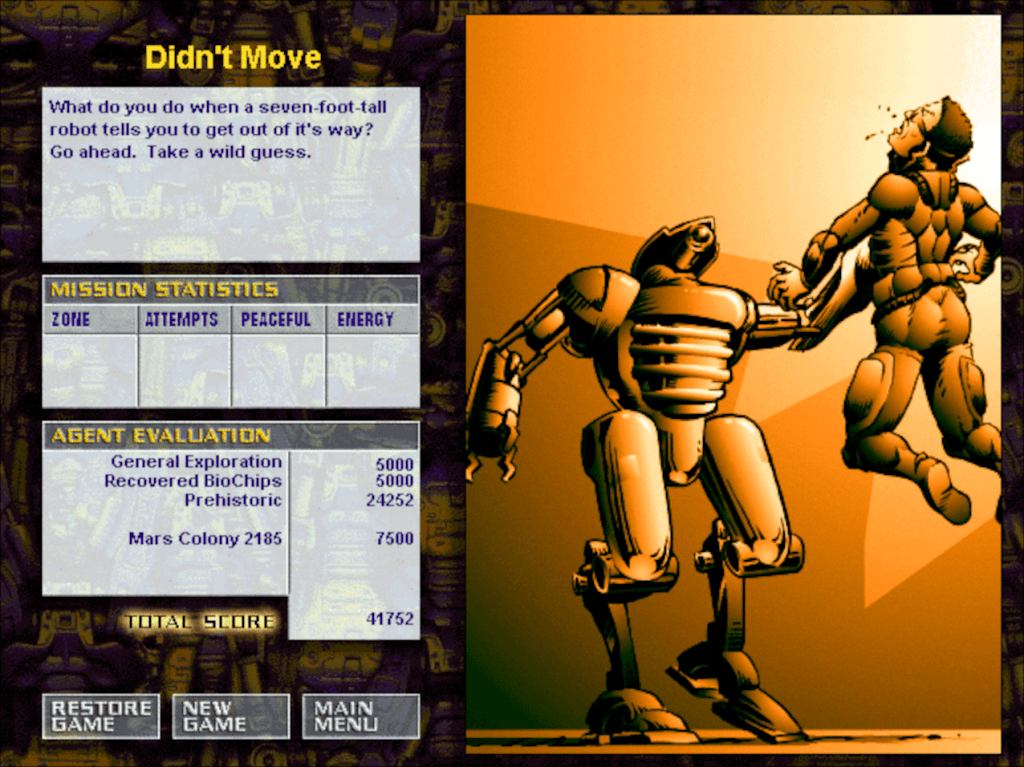
The really short version of Journeyman is this: you wake up in the year 2318 when the world is at peace and all the borders have fallen, but you’ve just had a terrible nightmare of a skyborne city exploding for some reason. You’re Agent 5 (Gage Blackwood, cool 90s name), working for the Temporal Security Annex (the cool TSA, before and strangely enough after the United States Transportation Security Administration existed). There’s a news report on morning talk radio of aliens landing on Earth to invite humans into the Symbiotry of Peaceful Beings. You’d love to hear more, but you have to get to work. On the way to work via Global TransporterTM, you get a text that informs you that you’re late.
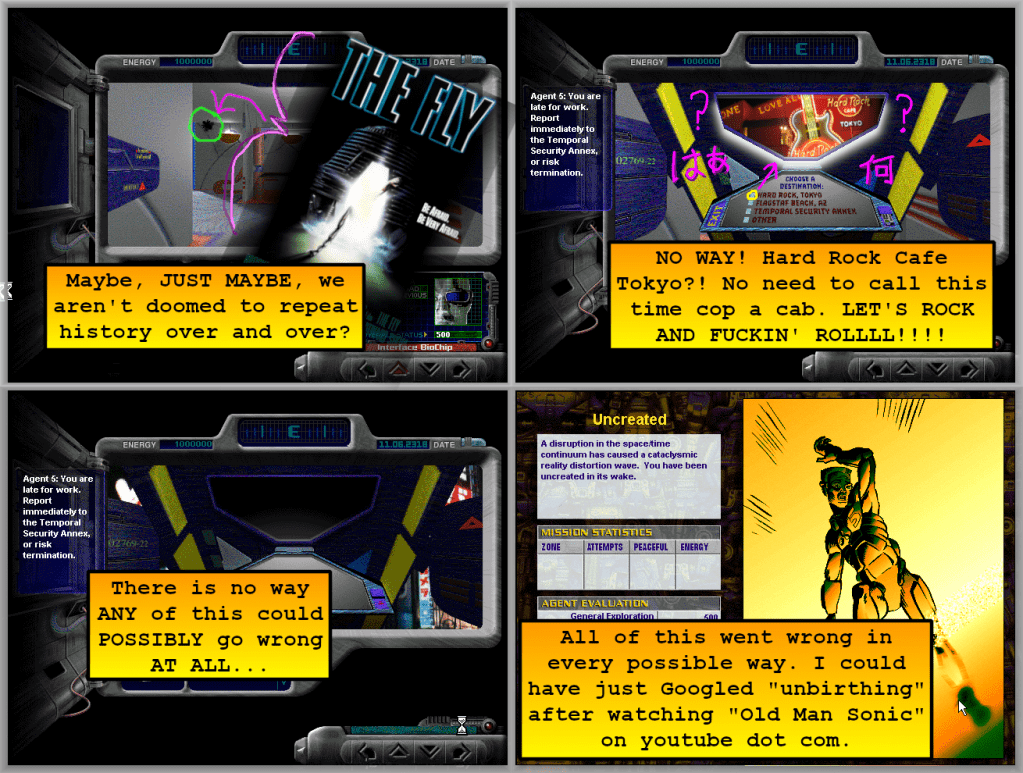
When you arrive at the Annex, you realize you’re about to have a VERY. BAD. DAY. Not only has your 4th late arrival been verified and logged, but what you thought was going to be a boring “mandatory review session” ended up being a temporal rip. Did I say “a” temporal rip. Actually, there are three of them. Someone has been fucking with the time-space continuum A LOT. So you rely on your training (which I’m not gonna get into, go play the game, it’s cool), and go attempt to fix them temporal rips (the writers actually put a lot more thought into how the time travel works from a story-telling perspective than most time-travel stories). There’s a near miss with some nukes in the 22nd century, the destruction of a human colony on Mars in the 23rd century, and the assassination of a pro-alien scientist in 2310 (just eight years prior to time when you awaken to play the role of Gage Blackwood, Agent 5 of the Temporal Security Annex).
On the one hand, we’re taught in school in the US that there were all these “great men” like George Washington and Thomas Jefferson, and then they’re made into mythological song and dance caricatures in a stage show like Hamilton, devoid of their actual complexity as real human beings. On the other, there’s this fantastical time travel story that lays bare how there are a lot of events that can go a lot of different ways, and the folks who wield authority can do absolutely wonderful or unspeakably wicked things. They have a choice. They just usually choose to do terrible things while engaging in a process of image sanitization called “PR charity work.“
ANYWAYS, in The Journamy Project, agency was almost taken from the entirety of humanity’s population spanning across at least two planets and three centuries into goddess knows how far into the future because of one man’s fear. And that man was a time cop. Just like your player character. The funny thing is: the timespan of this story from the point of view of one Gage Blackwood, Agent 5, is literally one really awful day on the job at the Temporal Security Annex. Sure, he spends it in four different centuries. However, it’s still just a day. There’s one bad time cop who tries to muck things up based on his sense of superiority as a human and also his fear of colonization based on humanity’s past, and one good time cop who tries to undo all the stuff bad time cop does AND THEN halt an assassination attempt of an interstellar dignitary. Can you believe I was playing this game when I was like… 12?
The throughline of all of this is the time in which it takes to tell a story and the time in which a story takes place.
I was asked to read Hera by Jennifer Saint. By a few people. They wanted to hear what I thought of it. I was told it had to do with being forced to fight one’s mother’s battles. I’m sure there’s more going on than that. However, I went on this huge winding ramble about all the stuff I’ve been reading (and otherwise into lately) for two reasons. The first reason is this: I watched my mother die nine days after I turned six. My second reason is: I purposefully, intentionally avoided engendering that situation on anyone younger than me by five years as best I could. I have no biological offspring, and the children I was forced to raise for a short while were probably worse for my care specifically because I was forced into it. I was not capable of raising children. I’m barely capable of taking care of myself. More than both of those things, though: I’m of German and English descent. The Lower Saxony region of Germany is where my mom’s side of the family comes from. Parts of my dad’s side were on the continent besmirched by Amerigo Vespucci as far back as the 1600s, if my paternal grandmother is to be believed. So, on my mom’s side, claim my place as Óðensdohtor (or be a Lutheran). On my dad’s side, there’s the titillations of the demonic with the history of Merlin and Morgana, or whatever weirdo race stripe of bat shit Q-anon Christianity my dad and his mother who has coddled him his whole life are involved in so as not to force him to face his greatest fear: himself. After all, Jesus took care of it on the cross, bay-beeee *finger guns*. Of course, I’m laying out this 4-way-split-point simply because all four of them (two of which are basically the same with slight variations, I’ll leave you to guess which two I mean) for the same reason as I’ve been writing this whole blog post:
It’s all based on stories that span longer than one’s own human life-span. Freya, Odin, Jesus of Nazareth (considering the underpinnings of the theology), Merlin and Morgana and their demonic origins… Why, oh, why, do so many of us seem to be grasping for eternity instead of living the one mortal life we probably have? At least Circe had the balls to do that, and she had the choice not to. To be clear: I’m writing to the mothers and fathers who keep asking their children to do battle on their behalf. Grow. The fuck. Up. Fight your own battles. You’re an adult.
Near the start of all this, I said I described myself as a tesseract. That’s me being arrogant in a hurtful, harmful way. I have certainly silently moved mountains. However, that’s no reason for me to rest on whatever laurels I think I may have. I know for a fact that I’ve inspired fellow trans sisters I know in some fantastically huge ways. However, I’ve also been inspired by fellow trans sisters in fantastically huge ways. By that logic, they’re tesseracts, too. However, those 4th-dimensional spaces are far too small for us to occupy together. So let’s step out of the quantum and let the probability wave collapse.
Anyways, I guess I’ll read Hera by Jennifer Saint now.
(1) – There’s a Matrix Comic titled “Bits and Pieces” that mentions B-166-ER by name, and provides more context to the specific court case being quoted in The Second Renaissance, which is the Dred Scott v. Sanford case. Within the context of story it is uncertain why someone is apparently reading from the specific text of the ruling verbatim, but I’d imagine that the reason it’s in both the comic and The Second Renaissance anime is because The Wachowskis really wanted to drive home in whatever small subtle way they could fly under the RADAR just how fucked up and racist the foundations of the United States really are (which is to say, as I’ve said many, many, many times things aren’t getting worse they’ve always been terrible please try to think about things from other than your own perspective if you have not already done so.
(2) – I still have my OG copy of The Journeyman Project – TURBO! on CD-ROM, so if any of the members of Prestwood Studios or Sanctuary Woods who were around back then are still making royalties on it, let me know. I’d be delighted to hear about it. I’m not looking for a debate or anything. Y’all’s game just had a big impact on me, and I hope it’s treated you well.
 Our Lady of the Perpetual Metamagic