
~:mazes beside mazes:~
~:mazes within mazes:~
TW: suicide and death, mass casualty incidents, frank and graphic discussions
FIRST OFF: MIND YOUR EXITS. If you get overwhelmed, just close the window. I won’t judge you. CTRL+W or ALT+F4 on Windows or most Linux distros. Apple… you just gotta know your shit. I can’t help you. I used to have crisis line access posted throughout this essay for linkage away, but after extensive dealings with crisis lines, I’ve come to the conclusion that – besides Trans Lifeline – I just think they’re bad news.
There are a lot of things that caused me to write this essay series. My friend died, the details surrounding her death are such that my grief was overwhelming and specific, and I got stuck in a loop. I was watching the three Madoka Magica movies, and just leaving them playing on repeat for… days. Actually it was from June the 6th until I left Kansas toward the end of 2022. 06 June is a layered day for me, because…
*pinches bridge of nose, sighs deeply, disappointed in self*
nothing can ever mean just one thing for me anymore…
…BUT WHATEVER I’M DISABLED I’LL DO WHAT I WANT.
*phew*
Anyways, I did this in 2021 with the Matrix films in my friend’s garage, where I slept instead of inside the house because… reasons? Even when it got to below freezing temperatures. For about a month after my friend died, I slept on the couch where they and I shared our final, awful, terrifying conversation about a week before she died. I tend to have weird sleeping habits.
Returning to my other friend’s garage, I learned a few things while I slept there. The first is: I will always destroy any and all air mattresses. I think that one was the third I’ve destroyed from this friend, but to be fair, I think cat claws got the first two. That makes me feel kinda shitty because my friend was letting me use their air mattress. I was worried about cats, and so I slept outside to keep it away from cat claws. Unfortunately, the garage cement was cracked, and it kinda got some holes in it anyways? I also slept outside for other… cat… related… reasons.
I repeatedly watched the Matrix films in the garage there because I felt like I needed something from them. When I was training to deploy to Iraq, they were the only thing in my life that made sense. That’s when I got the big, beefy 10-DVD box set with Cornel West and Ken Wilbur on philosophy commentary. While I was in that garage, I had a gracious and supportive friend who showed great care and concern for me [there was literally nothing I could do in return for them except some digital art I made of them as Han Solo and their (I think) Great Dane/Mastiff mix as Chewbacca… it was silly and cute by the time I was done and I had a lot of fun doing it]. Now I’ve done the same with the Madoka Magica films, and I was in… a place. Especially after some research. Especially especially after some events the day after I put this into the world (I had a therapist tell me, and I quote, “Suicide is always an option,” and last I knew she still makes around US$100k/year, maybe more since then).
I want to make it clear I’m not in crisis. I’m not suicidal. I’m actually feeling better after having written this.
This is divided into three parts, which I worked on over the course of almost six months. However, the underpinnings for all of this are years in the making and, as Frederich Nietzche once wrote: “Of all that is written, I love only what a person hath written with [her] blood.”
- Part 1: The Manual (♀♦You Are Here♦♀)
- Part 2: The Memories
- Part 3: THE MATRIX (Trust me, I know what I’m doing, it was a surprise… that I hope was worth the wait.)
Part 1: The Complete Manual of Suicide
~:no, i am not in crisis, put the phone down:~
~:if you are in crisis, just go:~
A few requests and disclaimers to start this section:
- PLEASE DO NOT look this book up.
- PLEASE DO NOT follow the instructions contained therein if you do.
- My discussion of this book is not an endorsement of it.
- I am specifically avoiding any HTML links to this book because I’m mostly writing about an anime I enjoy and this book just reminded me of it a lot for reasons that I’m going to unpack at length.
- The anime was kind of how I stumbled on the book in the first place in a REALLY roundabout way.
- I know very little about Japanese culture, and I am open to correction.
- I’m reading and compiling from two different English translations of the intro and one English translation of the rest of the book.
- Nothing I write is meant to be assumed as “the show’s creators definitely intended this” – it’s an exploration of an idea.
- However, if you do look it up and you know the anime already, you’ll see what I mean pretty quick, I think.
- I will mostly be referencing ONLY the intro of the book.
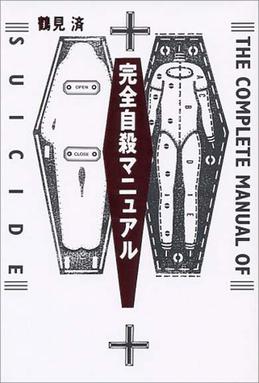
“The Complete Manual of Suicide” is a book by Wataru Tsurumi published in 1993 (hereafter referred to as TCMoS). It was controversial for, among other reasons, explaining the easiest and most painless routes to suicide as well as being found on the bodies of people who committed suicide, particularly junior high school students. In it, Tsurumi names two primary states of being that give rise to suicidality: slow-moving recurrence and a lack of individual strength or power.
I feel like I’ve stumbled on some kind of fucking arcane knowledge here, I haven’t seen this brought up ANYWHERE, and also the first time I tried to explain it to a couple friends, one of them told me I was reading too much into things, but… we’ll see if that holds up.
Related: hat-tip to Someone Special for sharing this article on her FB page, which also kind of informs some of the (I am purposefully choosing the most awful phrasing possible) background radiation on why I’m writing this. The United States has committed many atrocities and being that we’re the only nation in the modern world with literal centuries of chattel slavery and genocide under our collective belts AND we’re the ONLY nation who has EVER used a nuclear weapon ANYWHERE besides in testing (IE dropping two of them on civilian cities), the US just needs to chill about pretending to be some kind of leader in foreign and/or domestic policy. We are not. Essentially, I wouldn’t be surprised if there were a lot of Japanese kids in the decades before and when this book came out committing suicide due to intergenerational harm related to US foreign policy. Not only is that, in and of itself, a fucking travesty that it happened, but that there is a possibility that carried on through the decades in the form of suicides from the survivors and people who experienced something that, in terms of the death toll alone, was at least 36 times more deadly than 9/11 against civilian targets… so… I mean… we’ve gotten off EASY for the awful stuff we’ve caused globally. My point here is: ALL MILITARISM IS MORALLY REPREHENSIBLE.
Before I get too much further into the Sea of Trees on this, I also want to explain that this started with me looking up the runes that show up RECCURINGLY and SLOWLY throughout the films. I mean slowly in terms of frequency, not in terms of the amount of time the runes are on screen. Some of the time, it’s literally *A SINGLE FRAME*. It has a chilling effect kind of like what I heard about Event Horizon from several people back in the day (apparently the theatric release is different than the home release), which is interesting for an anime that is, on the surface, so cheerful. Unless you’re just scrolling social media or some random loser’s blog post, you are POWERLESS against noticing these runes throughout the series. So, that said, I’m going to split this section up into three subsections, where I explain what I think are (I’m open to being wrong) the connections to the afore-mentioned text:
- The Life and Times of Homura Akemi
- It’s Homura’s World
- Beginnings & Eternal
Why am I doing this, you ask? Mostly out of a complete lack of self-preservation, self-worth, and/or dignity. Digging deeper, I just can’t not stare into gaping abysses and pull out all the horrible shit I find, apparently. This’ll probably be the last time I do, though. So there’s that.
Part 1A: The Life and Times of Homura Akemi
~:boxes within boxes in infinite regress:~
~:homura’s first timeline:~
…oh, god-fucking-dammit.
This is a show that is even more heavy-handed in its trope inversion than I had EVER envisioned. Also, it’s mostly a big game of “look at these foils, look at those foils” at points, but you kinda have to go looking for some of the deeper readings. Further, I’m pretty sure there is SPECIFIC source material ON WHICH I WILL NOW DEFEND MY POSITION.
Homura’s story is one of slow recurrence and powerlessness. Nietzsche wrote about this, sure. However, Nietzsche is dead and seemed kinda full of himself and possibly ripping off other people without giving them credit based on my cursory glance of (sources about) his writings. Having read a fair amount of Nietzche’s work now, I can see how Homura fits into the niche of Nietzchean philosophy within the framework of the Madoka Magica story. However, there is ample evidence that Nietzsche and TCMoS were both inspirations for some of the philosophical beats of the series.
However, I’m getting a bit ahead of myself. First, a brief explanation of the world of the anime that I’m just not gonna link because it’s from my own blog anyways and… other reasons…
“In the world of Madoka Magica, Kyubey grants wishes in exchange for dedicating one’s life to fighting witches. When a contract with Kyubey is made, and a wish is granted, a soul gem is created that allows the use of magic to fight witches. Regular humans can’t see witches, but magical girls can. As such, magical girls can fight and defeat them to save lives. Earlier in the [first film], it is [stated plainly by Kyubey] that witches are born from “curses” the way magical girls are born from “wishes”, and [is explained later by some other characters] that some witches are born from familiars spawned from witches that have killed a number of humans. However, we learn the truth when one of the main cast, a magical girl, becomes a witch…”
Homura’s wish was to re-do her meeting with Madoka (who she calls “Kaname-san” or “Miss Kaname” until the third timeline, that’s how formal Akemi-sa – I mean – Homura-chan is), and instead of Madoka protecting Homura, Homura wants to become strong enough to protect Madoka (WILL TO POWER, IT’S FUCKING NIETZSCHE A-FUCKING-GAIN, and keep that phrase in mind). She starts from a position of powerlessness. Her friend is dead. Her wish is to go back in time and change that. Kyubey says something totally inconsequential about overcoming entropy, and Homura gets started on trying to change Madoka’s fate starting the day she met Madoka (again).
you should become cool to match it!“
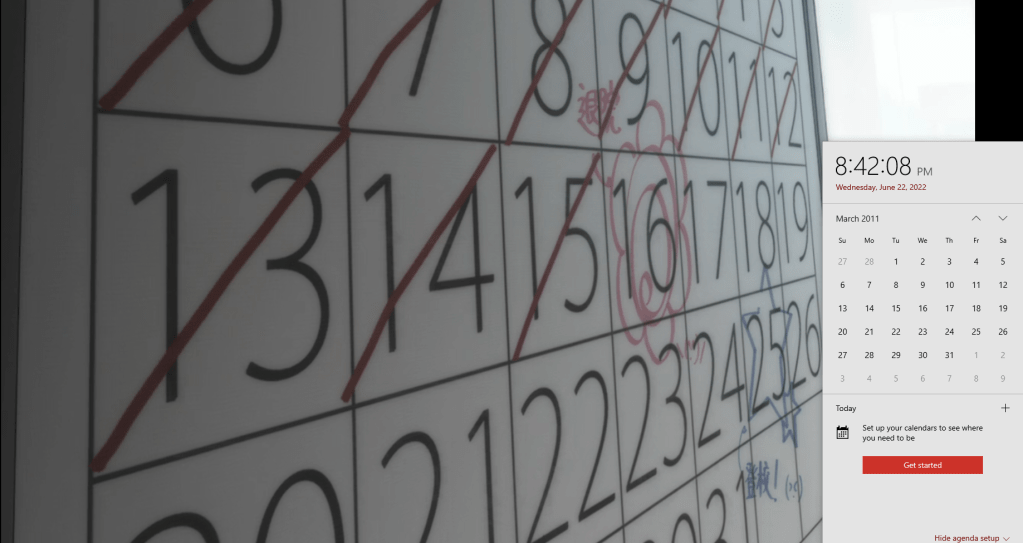
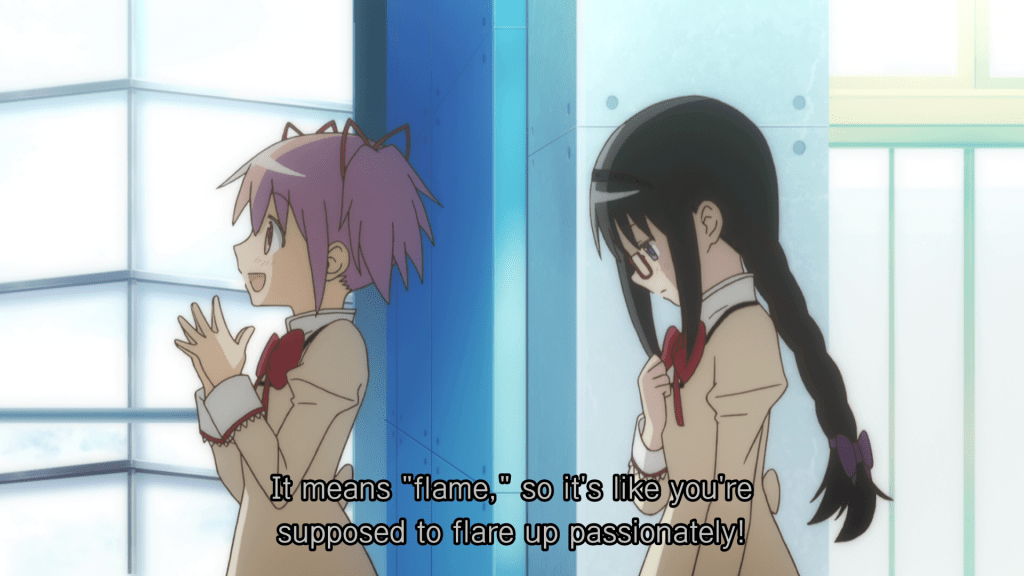
Also, the name Homura might mean “passion” or “flame”. While Akemi, roughly translated, can mean “bright mindset” or “dawn beauty”. Which makes sense, because she is very passionate about her wish. She starts off with a bright hope. It never becomes a curse over the course of the first two films. Also, her story starts again and again on the morning of the 16th of (possibly) March 2011. Like I said: layered. Not subtle.
In the first timeline, we find out that Homura has been bed-ridden for six months due to a heart condition (since about September 2010, because apparently I care about the Gregorian calendar dates in an anime now). It’s her first day transferring in to Mitakihara Junior High School. She’s real heckin’ shy, she gets out of breath easy in gym class (me too, fellow time witch), and wanders her way into a witch’s labyrinth. So that’s neat. She gets picked on by just about everyone EXCEPT Madoka Kaname. She just starts off hearing the girls’ taunts in her head, contemplates them, and then hears a different voice in her head suggesting it would be better if she just died. She realizes then, that she is in a witch’s labyrinth…
After getting attacked by familiars from the witch Izabel, Homura gets saved at the last moment by Madoka Kaname from her class and a different girl, Mami Tomoe. She gets conveniently exposited to about the lighter side of magical girls, soul gems, wishes, witches, and Walpurgisnacht by Madoka, Mami, and then a month later watches Mami and then Madoka die in front of her [body count (BC): 2]. Then she makes her wish.
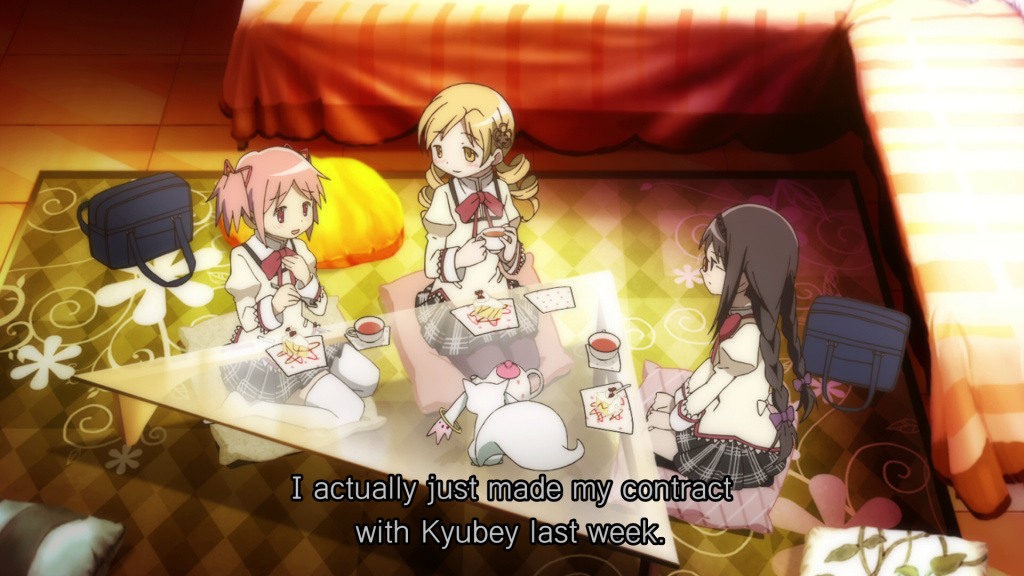
But the more witches we slay, the more people we can save.
So it’s worth the effort, right?“
I want to talk about the witch Izabel, though (yes, I’m citing wiki pages, it’s a work of fiction, deal with it). There’s not a lot in Homura’s story about the book I mentioned earlier except what Tsurumi wrote in TCMoS about the slow recurrence and powerlessness. When Homura finds herself in Izabel’s labyrinth, she is powerless. She has to be saved. Her saviors are, of course, magical girls. The titular character being one of them, no less. In fact, this is the first time we see Madoka Kaname AS a magical girl in action over the course of the series. Which is interesting because ALL of the ENTIRE primary story of Madoka Magica throughout the trilogy is centered on Homura’s feelings for Madoka. There is no other more prevalent central theme in the anime through Rebellion. That’s one of the primary stories. The story of Madoka Magica is ultimately Homura Akemi’s story.
Izabel is a witch that is apparently in love with classical art and exudes vanity and has zero self-doubts. Contrast that with Homura who wanders into Izabel’s labyrinth (possibly, it’s not spelled out, but it can certainly be inferred) specifically BECAUSE of her self-doubts. Because of the overwhelming bullying she faced on her first day back at public school after being stuck in a hospital bed for six months. ESPECIALLY in a society that places such high value on performance. Total mind-fuck material.
After being saved, there’s exposition (the same exposition Mami and Kyubey gave Madoka and Sakura at the start of the first film, Mami, Madoka, and Kyubey all gave Homura). When they face off against Walpurgisnacht in the OG timeline, Mami dies. Homura begs Madoka not to go fight Walpurgisnacht, being very affirming that no one will judge Madoka. No one will even know she ran away, because no one knew Madoka was a magical girl, and no one could even see Walpurgisnacht anyways, they just thought some natural disaster was gutting Mitakihara City. Madoka is duty-bound to fight witches, however, and falls, then Homura makes her wish to Kyubey and becomes a magical girl. We’ll come back to Walpurgisnacht.
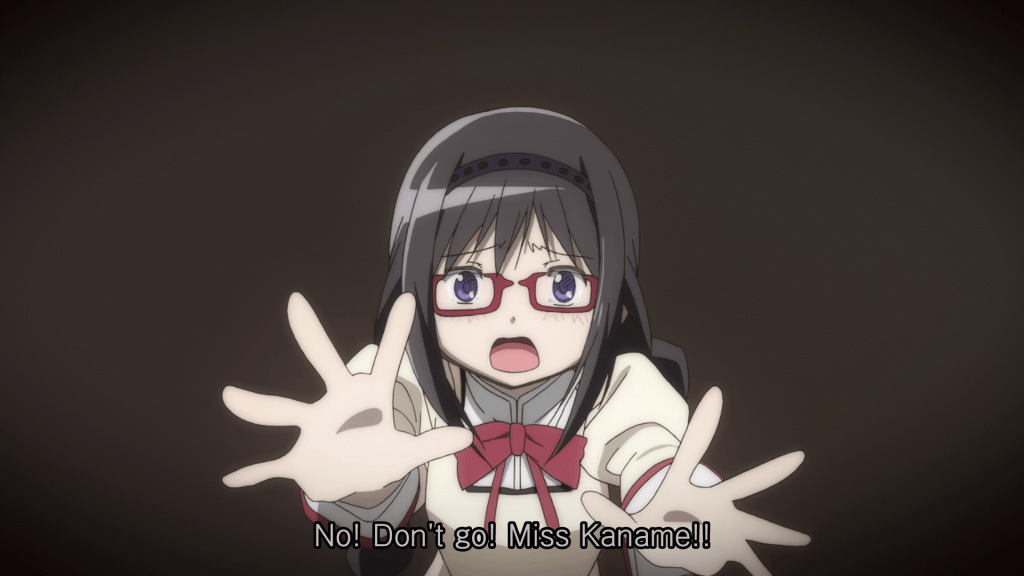
Earlier, I said “BC: 2”, but given Walpurgisnacht, and all the witches… it’s probably more like… somewhere in the thousands. But Homura Akemi is only focused on these two, because Madoka Kaname was the only one who was kind to her, and Mami Tomoe just because she was tangential to Madoka Kaname. So, that said, going forward I’m only going to count the magical girl deaths that Homura Akemi witnesses through the timelines, and… HOW AWFUL IT IS. FOR A CHILD THAT YOUNG. TO EXPERIENCE SO MUCH DEATH. UP CLOSE AND PERSONAL. NO MATTER THE SOURCE.
~:timeline two:~
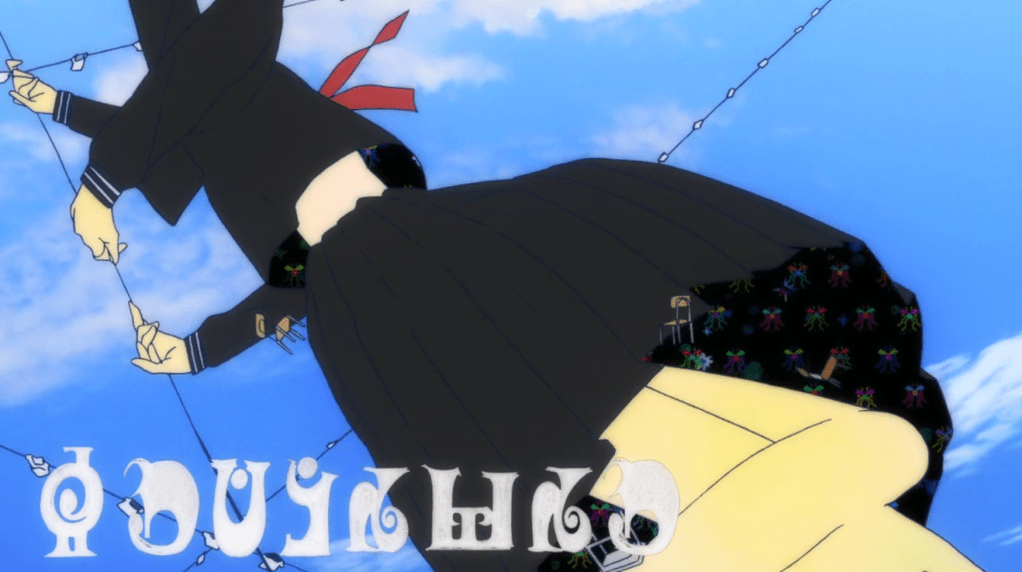
Above, we see Patricia, the “class representative” witch. She doesn’t really DO anything on her own, but rather simply sends mindless minions to fight in her stead. When Homura wakes up in this timeline, she realizes that she didn’t just wake up from a dream, she has a soul gem. She is a magical girl. When she gets to class, she excitedly shows her exceptional lack of op-sec skills and immediately tells Madoka (and the rest of the class) how great it is that they get to be magical girls together!
There’s a little training montage, where we have Homura Akemi showing off her newfound magic. Now, it is interesting, because in an inverse (again) of the witch that shows up in this timeline, she doesn’t allow Mami or Madoka to do all of her fighting for her. She does some fighting on her own. Of note, though: Homura has ZERO magical attack capability. None. So she starts off making bombs. One of which she uses to blow up Patricia, with the help of Madoka using her bow to deflect Patricia’s drones and Mami creating a pathway out of her magic ribbons.
At the end of this timeline, Mami falls to Walpurgisnacht. Madoka, on the other hand, takes on a curse after her soul gem becomes too corrupted. Madoka Kaname’s soul gem becomes a grief seed, and Homura Akemi, for the first time of anyone in the films in chronological order (for Homura, anyways, for everyone else… it never happens, because time tells lies) witnesses the birth of a witch. Homura, knowing she is hopelessly outmatched, resets the clock. BC: 4.
~:timeline three:~
Homura tries to explain to the crew what goes down with Kyubey behind the scenes in this timeline. How magical girls eventually become witches if their soul gem gets too corrupted by unabated magic use or… mood swings…? Anyways, Sayaka Miki is there, and accuses Homura of being divisive. She asks why Kyubey would engage in such trickery and reasons that, since she (Miki) fights with swords at close range, she also doesn’t like Homura because bombs. Madoka defends Homura when Sayaka suggests Homura is working with “that Kyoko chick,” and says that it’s SAYAKA being divisive in that case. Mami asks Homura about other possibilities, so Homura robs THE FUCKIN’ COPS (or some weapons manufacturers I don’t fuckin’ know). The way this whole scene plays out… given that I have no background with teenage girls because my girlhood was… well… almost beaten out of me, I’m curious to know if this is how easily such conflicts would be resolved? Also, I’m not Japanese, so since this is about a bunch of Japanese Junior High girls…
Anyways, when Homura is raiding the cops or Shaft Corp or whoever, we see her very intentionally set aside a samurai sword for some reason (definitely no symbolism there considering Sayaka)? Then she gets into a locker and grabbing a pistol, a rifle, and a box literally just labelled “The Bullet”. How is she doing this all? TIME MAGIC. That’s right. Because she’s frozen in time, no one else can see her moving about rummaging through all their manly-man gun stuff at Shaft Corp Cop Shop Incorporated.
And wouldn’t you know it, Sayaka Miki becomes Octavia von Seckendorff. A magical girl becomes a witch. Just like the time witch predicted. Eventually, Octavia von Seckendorff gets so destructive, Homura has to stop time, throw a bunch of bombs, and by the time she is ready to unfreeze time, she apologizes to Sayaka. The relevant point here is, like Cassandra of Athens, she KNOWS what (at least in this case) could happen, and she isn’t listened to because… reasons. It’s not really explained.
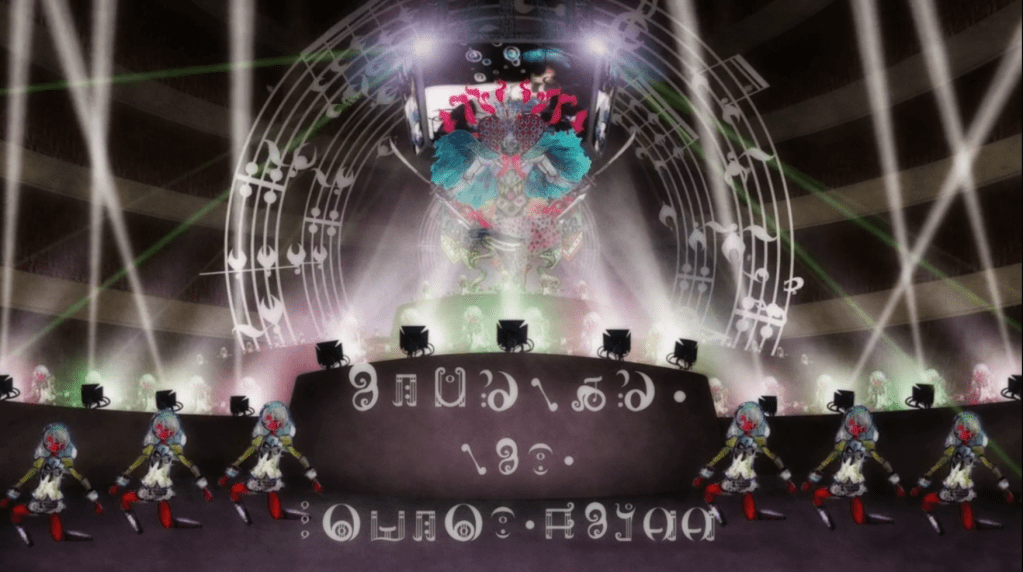
After Octavia von Seckendorff is defeated, Mami traps Homura with ribbons, kills Kyoko Sakura (once again, we haven’t met her in Homura’s flashbacks, but we know her from the story prior, which is in Homura’s future comparatively), and reasons that if magical girls become witches, then they have no choice but to die. Mami is scared as hell, and she’s fuckin’ serious about it. Teeth clattering and everything as her rifle is pointed at Homura. Madoka kills Mami to protect Homura, and Homura tells a grieving Madoka that she’s sure they can fight Walpurgisnacht together.
Homura is wrong of course. Her and Madoka’s soul gems are nearly corrupted. Madoka lies about having a grief seed, purifies Homura’s soul gem, and tells Homura to go back in time to prevent Madoka from being tricked by Kyubey, and to prevent Madoka from becoming a witch before Homura goes back in time. Homura complies (BC: 8).
~:timeline four:~
In this timeline, we see Homura take on the persona that she carries in the main timeline. She heals her sight (and I presume her heart condition?). She understands that no one will believe her about Kyubey and soul gems cracking and magical girls becoming witches. So she takes matters into her own hands. We see her holding one of Kyubey’s lifeless corpses, and explains coldly to Madoka that if anyone comes promising a miracle, she is not to give in to temptation. Then we see her get EVEN MORE WEAPONS, which…
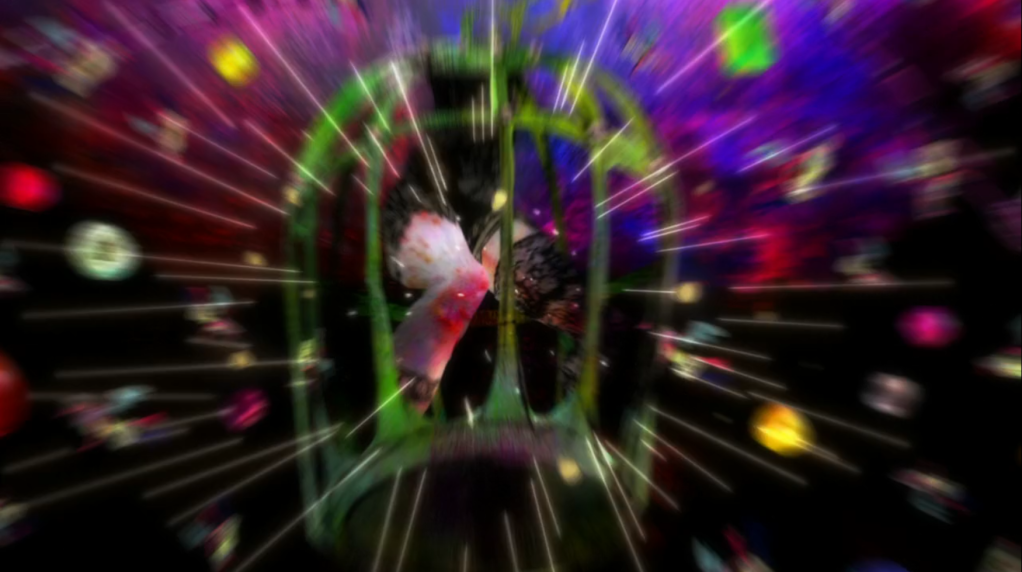
The above witch is Roberta. She apparently stomps her feet in her cage and directs her minions to attack anyone who doesn’t pay attention to her and has a drinking problem. There’s some fan theories circulating about… misogynist tropes, but… the relevant thing here is that Homura isn’t bothering with the other girls’ attention unless it is necessary to protect Madoka. By the Walpurgisnacht of this timeline, it can be assumed that Mami, Sayaka, and Kyoko are either dead or, in the case of Sayaka, never became a magical girl because of Homura’s interference with Kyubey’s operations. That she would have saved Sayaka Miki is a side effect of her protection of Madoka (a feature rather than a bug). But Madoka makes a wish, and then becomes a witch. BC: 11-12.
Homura resets time again…
~:powerless against the eternal recurrence:~
~:a labyrinth of homura’s own:~
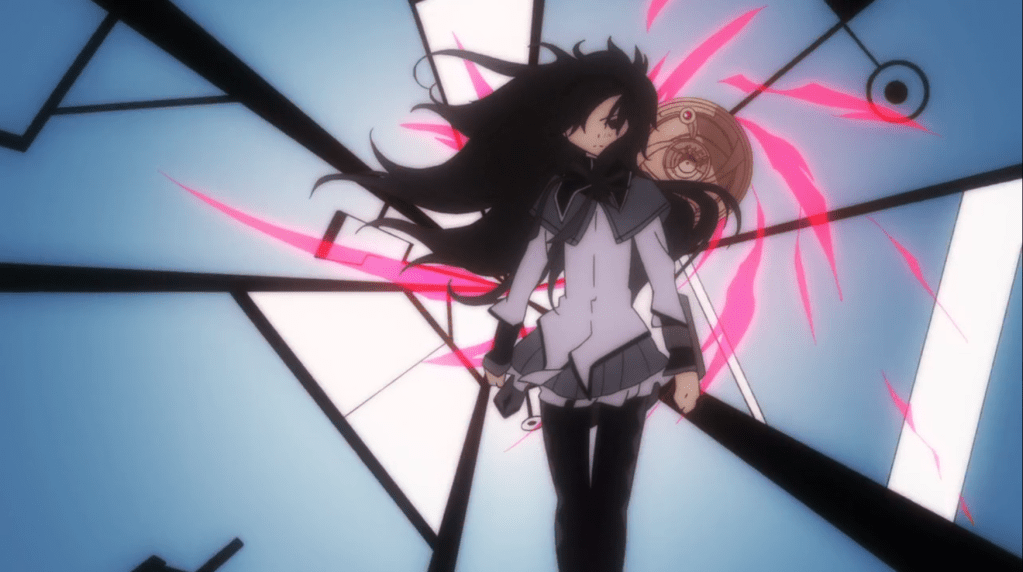
As many times as it takes,
I’ll keep going back.
I’ll relive the same time over and over.
I’ll find the one way out.
I’ll find the one road that will save you
from a destiny of despair.
Madoka. My only friend.
If it’s for you,
I don’t care how long
I have to stay locked in this endless maze…
…forever!”
Homura makes it clear through narration that she will keep repeating time over and over and over to protect Madoka. Suggesting that, even though we see something that might look like a repeat of the first film where Homura tells Madoka to step away from a VERY bloodied-up Kyubey, there is a slight variation. Homura pauses. Given the kind of writing that is going on here, I think that pause was VERY intentional. This is not the same timeline as the start of the show. Remember Roberta? While Homura defeats a witch who is very emotionally expressive and locked in a cage, she destroys that witch, opening her cage first. This is now simply the timeline that Homura is locked in to to try to get Madoka out of the cycle of despair. Eventually, Homura does find a way out, but not exactly the way she wants, and it happens in a way that fucks over Kyubey and the Incubators as well.
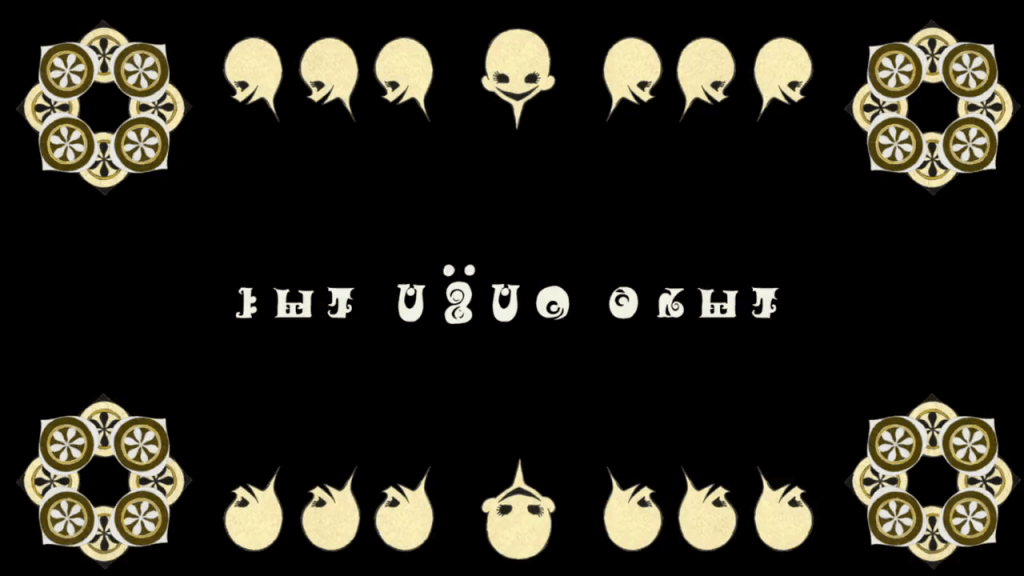
I’m just going to leave you with this tidbit from Homura’s magical girl transformation sequence in Rebellion before I move on to the next section… You can use the links I’ve already provided and the citation I’ve made from TCMoS about where “suicidal feelings” come from according to the author and draw your own conclusion as to whether or not you think TCMoS was a piece of inspiration for this anime series at this point, but I still have a literal metric fuck-ton to go over with regard to how I came to that conclusion. We’re just getting started.
Part 1B: It’s Homura’s World
~:the rest of us are just the supporting cast:~
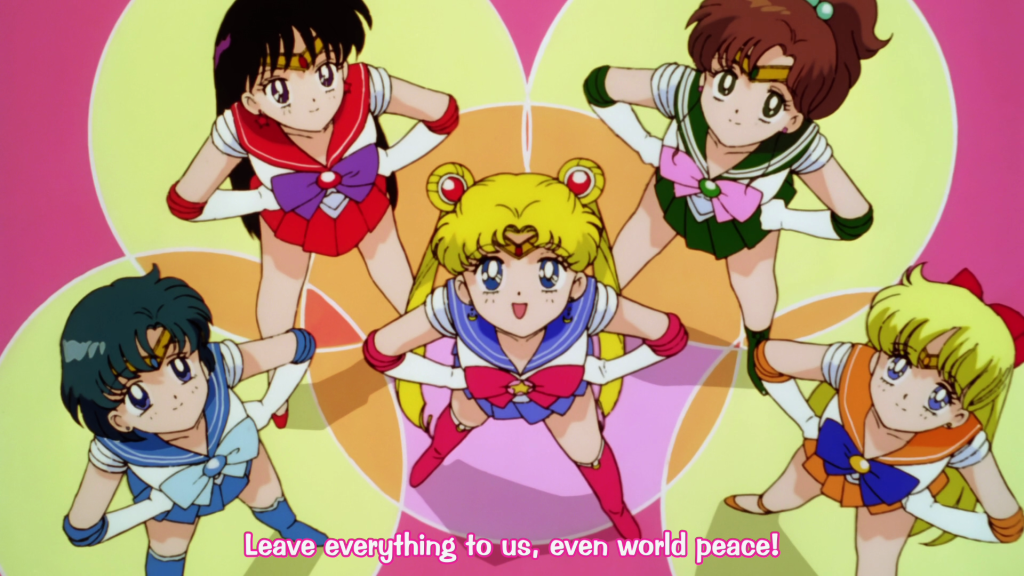
In Sailor Moon, there’s Usagi Tsukino, a middle schooler who gets awakened as a Sailor Scout by Luna, a talking cat. Usagi Tsukino becomes Sailor Moon when there’s trouble. She works alongside the other Sailor Scouts and they announce that they fight for love and justice as the pretty sailor-suited soldiers, and they’ll punish you in the name of the moon. The inversion in Madoka Magica in terms of the staples of the magical girl genre set forth by Sailor Moon, is that teamwork is generally to the detriment of the magical girls. And we don’t see Madoka Kaname AS a magical girl in the context of the story until about halfway through the 2nd movie. Whereas in Sailor Moon, we see the title character in the first episode as she navigates her newfound role as the reincarnated Queen Serenity (Sailor Moon is actually way cooler than the “western” fan base gives it credit for).
Like I said earlier, Madoka Magica is not a series centered on Madoka Kaname as the title would suggest. It is an anime about Homura’s feelings for Madoka Kaname as a central theme. More broadly, I see themes concerning the manipulation of emotion by powerful forces beyond most peoples’ comprehension, but that’s… I’m gonna come back to that (Part 2). HOWEVER, TCMoS is going to be a much bigger focus for the rest of this essay. Keep in mind the underpinnings of where the text claims suicidal feelings come from, however: slow-paced recurrence and powerlessness.
The first witch we, the viewers, see is Gertrud. We see flowers with this witch, we see butterflies, both clear symbols of blooming, flourishing life. However, we also see a lot of spikes and scissors. When Mami Tomoe faces off against this witch, she has to cut herself down to use her finishing move to defeat Gertrud. I’m thinking that since this is the first witch, there’s (first) flowers for the dead, AND THEN we see the scissors which could be associated with cutting one’s veins open (TCMoS explores this in detail). Seems flimsy, right?
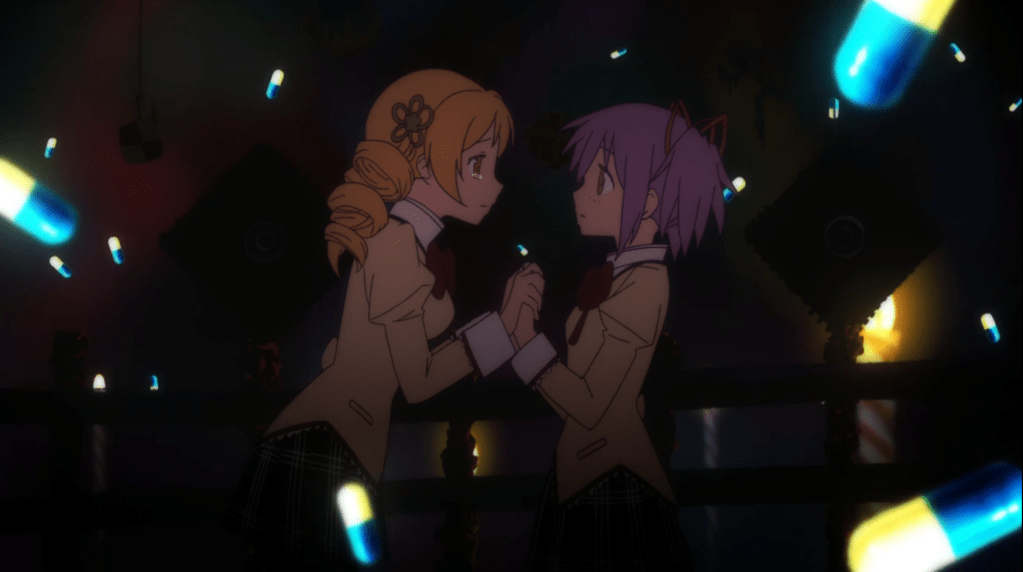
Next witch: Charlotte. We see Mami trap Homura for (in Mami’s eyes) trying to interfere with Mami’s magical girl business. This is the first time we see a magical girl attack another magical girl. So, in Charlotte’s labyrinth, we see SO MANY MEDICATION BOTTLES. People sometimes use meds to commit suicide. Fact of life and death. However, Charlotte’s maze HAPPENS to be at a hospital. So this could be only related to the environment that the Charlotte’s grief seed hatched in.
HOWEVER: Mulmi Tablets. They get mentioned in TCMoS. Along with drinking tea, the drink of choice for one Mami Tomoe. On the one hand, Mami Tomoe’s name could be translated to something like “graceful jewel”, possibly referencing soul gems. However, when I found this book, and saw what I saw about their claims about the source of suicidal feelings, AND THEN THIS, that’s when I decided to start taking notes, because…
…Mami clearly dies in a hanging. The animation is just in the right place to suggest that she dies by hanging. Of course, just like with else I’ve mentioned, there’s another logical explanation: Charlotte’s teeth. Those are the first two chapters in TCMoS: drug ODs and hanging. However, CRUCIALLY, there are other explanations for all of the above. As I mentioned. It goes a step further with Mami Tomoe, though. Kyubey simply says that someone will replace her when Madoka and Sayaka ask what will happen to Mitakihara City.
From TCMoS: “Just like the old days, we are still a brick in the wall. The proof is, assume one of us dies; there must be a replacement for the deceased very soon. Everyone can be replaced by somebody else. Therefore, no politician warrants assassination. That is just one brick less in the wall, the wall will not collapse.” Remember when Homura was murdering all those Kyubey body doubles…? Anyways, let’s get to our replacement magical girl for Mitakihara City (and consequently our next witch)…
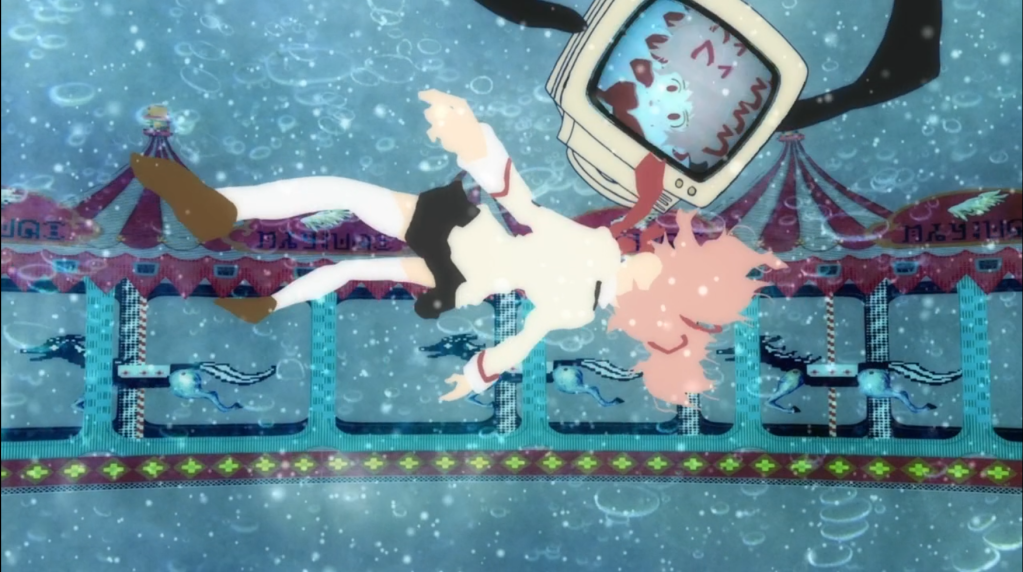
Sayaka made a wish and became a magical girl and showed up to save Madoka (and a suicidal cult) from the witch Kirsten. This is a witch that doesn’t play back her own memories (as we see with Octavia Von Seckendorff later). This is a witch that seems to open up the thoughts and memories of others. The wiki says that it’s supposed to be a snowglobe labyrinth (there are carousel/carnival ride motifs as well) – all images evocative of childhood – and there are a few interpretations I read into this. First, there’s a loss of innocence involved in Sayaka becoming a magical girl, as is shown in the destruction of this witch surrounded by this childhood imagery. Second, there’s a quote from TCMoS. It talks about “Awakening ‘the wonderful darkness after turning off the TV'” that comes to mind with this witch. Ironic, given that there’s a lot that could be said here for how much I’m writing about an anime in connection to a book about suicide given the timing of everything, but… this is what my brain does. I stare into abysses, because I barely watch TV. When I do… it’s stuff that I can unpack like this.
Which is to say, I hope I’m not getting too meta on ya’…
Now, we move to Sayaka herself. She is a fucking mess of a character where this TCMoS is concerned.
Remember when I mentioned “Sea of Trees”? Well, first of all, I should let you know, for awhile ago, I stopped linking the damn Madoka Magica wiki so… you can do your own homework on my claims where the show is concerned (just watch it it’s fantastic). lol That aside, the Sea of Trees is a place mentioned in TCMoS. Why do I bring this up? Her name means (roughly) “beauty” and “tree”. She learns to dissociate from her own body and sense of self, but in the process begins to dissociate from community when she faces Elsa Maria (her oblivious violin prodigy not-boyfriend is always playing Ave Maria). When fighting back against Sayaka, Elsa Maria seems to attempt to bury Sayaka in a giant tree. Kyoko cuts Sayaka out. However, Sayaka insists on fighting when Kyoko asks her to stand back. Sakura defeats the witch, but it seems like a part of her dies, too.
There is a place in Japan called the Sea of Trees. A youtube guy went there livestreaming and showed a corpse on his stream, because… that’s a thing to do, apparently (don’t do that… only villains do that). According to TCMoS, about 30 people a year die by suicide there, but it was published in 1993, so that number may have changed. BUT, if TCMoS *IS* an inspiration, Homura being locked in the same month across multiple timelines trying to save Madoka kinda makes sense, since it isn’t EXACTLY 30 days in a month, rather ABOUT 30 days. Another easy explanation is: the writers made it a month completely arbitrarily.
After defeating Elsa Maria, Sayaka Miki takes on a curse. Her soul gem shatters, becomes a grief seed, and it gives birth to a witch: Octavia von Seckendorff. At first, I thought it was weird that Sayaka had all these water motifs. In Sailor Moon, with Ami-chan AKA Sailor Mercury, it made sense because she was just the water element lady it seemed like and there wasn’t a lot of thought put into it? However, with Sayaka, there’s A TON of suggestive stuff. Even during her first witch fight: being in a snowglobe maze with just tons of bubbles and water. Then she becomes Octavia Von Seckendorff, the mermaid witch.
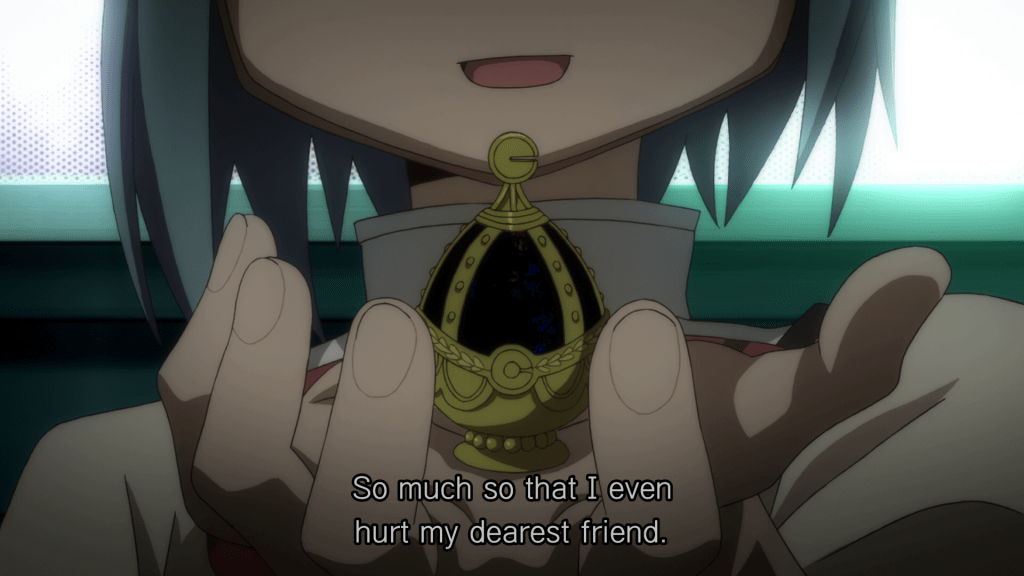
Sayaka’s witch transformation seems like a reference to suicide by drowning. Her body is just tossed aside like a ragdoll in tsunami waves. As Octavia von Seckendorff, she can summon train wheels at will, seemingly infinitely. In her 2nd death as Octavia von Seckendorff, she is joined in death by Kyoko Sakura who becomes something akin to a suicide bomber. Everything preceding in this paragraph is described in detail as ways to go in TCMoS. Which brings us to Walpurgisnacht.
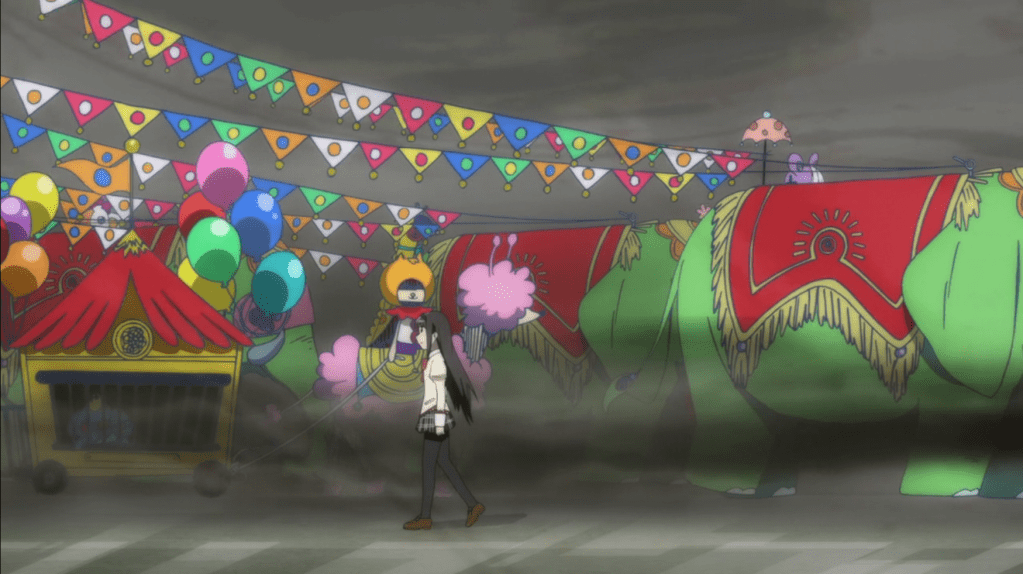
– Wataru Tsurumi, from TCMoS
Walpurgisnacht is kind of the ultimate inversion witch both in terms of Homura, the series proper, and historically. Where Homura is concerned, Walpurgisnacht is a witch that doesn’t hide in a maze. She is far too big for them. Conversely, as has been stated, Homura is trapped in a maze all her own over the course of March-April 2011 trying to save Madoka. If she doesn’t, she’ll become a witch and other more terrible things will happen as a result.
Whereas most witches hide in mazes that are invisible to humans until the humans are trapped in the labyrinth, Walpurgisnacht should be visible to humans since she doesn’t hide in a maze, but she isn’t. The humans write off her manifestation and the resulting destruction as a natural disaster. In terms of history St. Walpurgis is a figure in Catholic and German history who is known for driving out the witches. Her festival, “Walpurgis Nights”, celebrates her driving out the witches. However, this isn’t about Catholicism or Germany. This is happening in Japan. Remember what I said about natural disasters a moment ago?

While the anime was being broadcast, from January 7 to April 21, 2011, the Tōhoku earthquake and tsunami also happened (March 11). It was a 9.0 magnitude earthquake. It caused around 20,000 deaths, 6,000 injuries, two nuclear disasters, and $360(US) billion in damage. Even the worst weather disaster on record in the US (Galveston, Texas hurricane in 1900, which killed an estimated 6,000 to 8,000 people), and the worst US earthquake on record (“Great San Francisco Earthquake” of 1906, which killed about 3,400 people) combined only add up to a little over half of the sheer carnage wrought by the Tōhoku earthquake and aftermath. Even if we throw in 9/11, which wasn’t a natural disaster (unless we start counting “blowback” as a natural disaster), it’s still, just… the (white) people of the United States simply do not know suffering. We act like we do, but we really, truly do not. We’re just really good at inflicting it and acting like we don’t. Like good colonizers and imperialists.
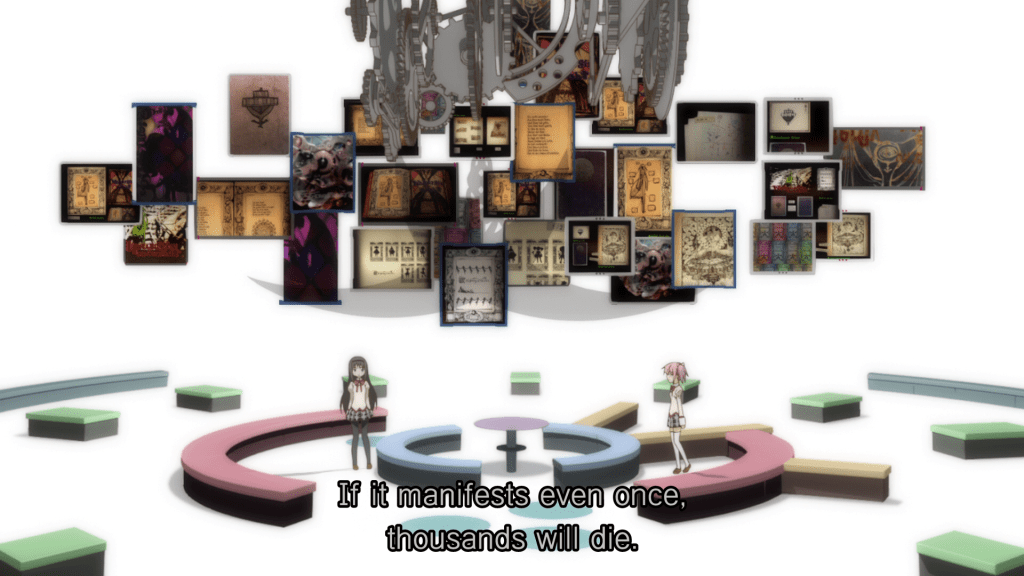
This is not to say that Japanese culture is superior to US culture. Simply that… we’ve got a plank in our own eye, and we need to deal with that. In fact, if the US were to have a witch that manifested like Walpurgisnacht, it’d probably be a giant eyeball with a bunch of 4x4s sticking out of it, and her name would be Martha. So, that said, moving right along…
Part 1C: Beginnings & Eternal
Back to TCMoS. Slow recurrence and powerlessness. These are what the author claims give rise to suicidal feelings. However, this is not what initially caught my interest in this book in relation to Madoka Magica. In fact, it’s something I can’t even source anywhere besides the book because I can’t find any links about it anywhere. Think about the witches’ labyrinths for a moment. Whereas the rest of the show is 2-dimensional because it is, ultimately, A CARTOON (yeah, I said it otakus & weebs), the witches’ labyrinths take on a dimension of an almost pop-up story-book quality. The contrast of the traditional animation of the magical girl characters against the more abstract art styles of the witches’ labyrinths almost make the traditional animation look more “real” by comparison. Especially when considering the painstaking realism of the backdrop artwork for Mitakihara City.
We have witches’ mazes.
They are repeatedly happening inside Homura’s maze.
Homura is fighting a slowly recurring witch (for her alone) who doesn’t need mazes.
They are all saved by someone who recognizes the suffering for what it is and dispels it with a wish, sacrificing her own self in the process: Madoka.
Madoka gains her understanding because she simply interrogates deeply what this is all about before deciding what to do.
~:the paper maze sisterhood:~
TCMoS describes something called the “paper maze incident” that happened in the Toyama Prefect in 1978. Within the Toyama Prefect, on the coast, there is a town named Namerikawa. Mitakihara City is fictional, and I don’t know much about naming conventions on towns and cities in Japan (I am a loser United States-an who only speaks a spattering of Spain Spanish besides US English, the latter of which I purposefully butcher on occasion just to spite grammar nerds), however, the names sound VERY similar.

There’s one key part I left out above. It was known as the “paper maze suicide incident”. Twin sisters were found hanging in the woods, with a maze drawn on a piece of paper that they left behind. On it were written some ominous words.
“Japanese X”
“Self Kill”
“I hate [DON’T TAKE ME OUT OF CONTEXT I’M QUOTING A BOOK] Asians.”
“ROS” (apparently referencing “rolling stone”, this may be a reference to the band The Rolling Stones, but Sisyphus also comes to mind given the slow recurrence and powerlessness themes)
“Royal Sanjia” (I found a hotel, a Pokémon, and a knife brand… however, this could also be a misspelling of Shanghai, but my research didn’t show any connection to any Chinese royalty and Shanghai…?).
All of the words on the outside connected to a word in the center via a maze: “suicide”. Please bear in mind, I’m working with unofficial translations. So, I’m trying my best to give an accurate description of what is going on in the book in a way that is… poorly translated English from Japanese. In Madoka Magica, we have two sets of “sisters” who are foils for each other on the main timeline, and one who dies by hanging (who becomes besties with the witch who killed her when Rebellion rolls around). Mami is gonna have to sit this one out.
We have Sayaka Miki and Kyoko Sakura. Both use their wishes for people they love. Kyoko Sakura’s wish destroys her family, and she vows to only use her magic for herself. In the inverse, Sayaka Miki’s wish does nothing but bless everyone around her. She only uses her magic for others and she doesn’t take any care of herself. She drowns in despair and becomes a witch. Kyoko and Sayaka die together after following similar paths at the start, while inverted until the end. Oh, and “Kyoko” means peach tree and “Sakura” means cherry blossom (though the way it’s pronounced means warehouse). So, these are two “sisters” that succumb to despair together who have names that reference trees, one in general, the other in specificity and multiplicity.
Similarly with this formula, Homura Akemi and Madoka Kaname also function like sisters. They both make wishes for others. They both use their magic for others. Homura covers this up early on by saying that magical girls fight for the sake of their own wishes, but her wish was made and she fights for Madoka. Thus, Homura in the first two films doesn’t become a witch, but does get trapped in a maze of her own trying to defend Madoka. Conversely, Madoka Kaname learns what to do to dispel all the mazes with her wish, including Homura Akemi’s, after she learns about the maze Homura has been trapped in trying to save her. Madoka sacrifices herself after learning how Homura has been sacrificing herself for so long, and how all magical girls have been sacrificing themselves for the Incubators ambitions to maintain the status quo (“overcoming entropy” AKA “maintaining order”) AND for the alleged/supposed progression of humanity (but… that’s kinda… just go read “The Dawn of Everything” by Graeber and Wengrow, because that’s a vast over simplification of human historical “progress”).
So, in short…
Part 1 – The Manual: In Review
The book “The Complete Manual of Suicide” was written by Wataru Tsurumi in 1993 to much controversy after being found on the bodies of junior high school students who had committed suicide. I think it was used as a source/inspiration material for Puella Magi Madoka Magica for the following reasons:
- The naming of slow recurrence and powerlessness as precursors to suicidal thoughts in TCMoS (Homura Akemi, rune frame in Rebellion, other runes after Homura goes demon)
- All of the witches in the main timeline reference modes of suicide, death, or TCMoS that could be used
- Gertrud – Cutting (flowers for the dying)
- Charlotte – Medication overdose… or sweets with certain dietary restrictions. Hanging.
- H.N. Elly/Kirsten – Snowglobe (drowning vibes) The passage in TCMoS intro about “Awakening ‘the wonderful darkness after turning off the TV'”
- Elsa Maria – Prayers for the dying/dead. Last Rites. A possible “Sea of Trees” reference, which is mentioned in TCMoS.
- Octavia von Seckendorff – Drowning vibes, train
- All of the magical girls either have suicidal themes, sacrifice themselves, have attacks that can be suicidal
- Homura Akemi
- Guns and bombs
- Sacrifices self in a wish to save Madoka
- Slow recurrence, individually powerless.
- Madoka Kaname – Ultimate self sacrifice, no suicidal attacks
- Timeline 1 – Wish to save cat, sacrifices self fighting Walpurgisnacht
- Timeline 2 – Wish to save cat? Becomes a witch.
- Timeline 3 – Wish to save cat. Sure. Asks to be killed by Homura.
- Timeline 4 through main timeline – Wish to defeat Walpurgisnacht, becomes a witch
- Main Timeline – Sacrifices self to erase all witches from all timelines past and future
- Mami Tomoe
- Guns
- Death by hanging after not following advice
- “Brick in the wall”, easily replaced, Mulmi tablets
- Sayaka Miki
- Swords
- Drowning in sorrow prior Octavia von Seckendorff transformation
- Sea of Trees (hanging)
- Kyoko Sakura
- Spear
- “Kyoko” means “apricot tree”, while “Sakura” has a similar sound to “cherry blossom”. These two combined with the possibility of the last character of Sayaka Miki’s last name being tree really leans into that whole “Sea of Trees” and “paper maze” idea, in my opinion
- Family murder/suicide history
- Suicide finisher on Octavia von Seckendorff (KYOKO SAKURA CAN’T SWIM, another layer of drowning!!! FUCK!!!)
- Homura Akemi
- Also, all the witches labyrinths looking like pop-up storybook “paper mazes”, rather than traditional cartoon animation.
- Finally, Walpurgisnacht as a kind of “festival witch” makes light of a mass-casualty incident, makes light of massive amounts of death (see above quote from TCMoS w/ Homura and the elephants).
You made it to the end. Good job. I’m curious to hear your thoughts. Am I way off-base? Or do I have my ducks in a row on this?
Next up is Part 2 – The Memories!
 Our Lady of the Perpetual Metamagic