
~:mazes beside mazes:~
~:mazes within mazes:~
~:mazes of the mind:~
~:mazes of memories:~
and ope you got me this is actually about all about The Matrix
I finished this in January 2023.
I posted the first “Adherents” writing in June of 2022.
Time flies faster than you can blink.
This is an essay about the themes and symbolism in The Matrix: a comic, anime, and video game series popular and beloved by many around the globe. It is the final part of a 3-part essay series, and I highly recommend recommend the other two. I worked hard on them. Please heed the trigger warnings. As with the other two essays, this does not speak to author intent, only explorations of ideas and what I see in the text.
Part 1: The Manual
Part 2: The Memories
Part 3: The Matrix (♀♦You Are Here♦♀)
Part 3: The Matrix
Where do I even begin? PREREQUISITES. That’s where. I’m assuming you’ve watched Puella Magi Madoka Magica Beginnings, Eternal, and Rebellion (or at least the OG Anime and Rebellion), and the four main Matrix films and Animatrix. Maybe also reading Part 1 and Part 2 in this series…? Anyways… The THESIS of this piece is The Matrix and Madoka Magica are the same films.
Side note (added 28Nov2023): if you’ve read Tilly Bridges’ Begin Transmission, that’s neat. It’s a good book, and I recommend it. I’m coming from a different angle, but I feel it contradicts nothing that Bridges writes. It’s all about that sweet sweet juxtaposition. I get the importance of the trans allegory of The Matrix as a body of work (referenced as “The Matrix*” to differentiate between the first film and the body of work as a whole from here on). However, The Matrix* was always BIGGER than a trans film for me. It was about how hateful and oppressive power is in all ways, intersectionally. As Sophie from Mars and Sarah Zedig said in their vid on the sequels: all of that messaging comes from an incredibly trans lens. However, for me, The Matrix* was always about bigger questions about the world we live in and how to exist in it in kinder ways. IN SHORT: the version of the color theory I write about is based on what Cornel West and Ken Wilbur talk about in the philosophy commentary tracks on the DVDs. Bridges’ version is more in-depth. The two don’t contradict each other in my opinion.
The Matrix was the first piece of media that felt real to me when I saw the first film in 1999. Madoka Magica hit all the same emotional and philosophical notes that The Matrix did as a body of work (see also Detransition, Baby by Torrey Peters and The Vanishing Half by Britt Bennett). I never could piece together why until recently. It’s because, obviously, MADOKA MAGICA IS A BIG TRANSITION METAPHOR BECAUSE TRANS GIRLS BECOME TRANS WOMEN WHEN THEY MAKE A CONTRACT WITH DUDES IN WHITE LAB COATS (/joking).
I have some feels about reducing pieces of media to just one thing, and seeing The Matrix getting reduced to a transition allegory does it an extreme disservice in my opinion. That’s not to say there ISN’T a transition allegory in The Matrix. There is. It’s STRONG. It’s just to say that the transition allegory was so deeply layered under Socrates, Marx, Baudrillard, et al. that the just about the only person who noticed it very clearly was a blogger back when the OG sequels were still in production, and that was over a decade before Lana Wachowski would take the stage at that HRC soiree in 2012 to give her big coming out speech.
Part 3A: Hope, Despair, and Rainbows.
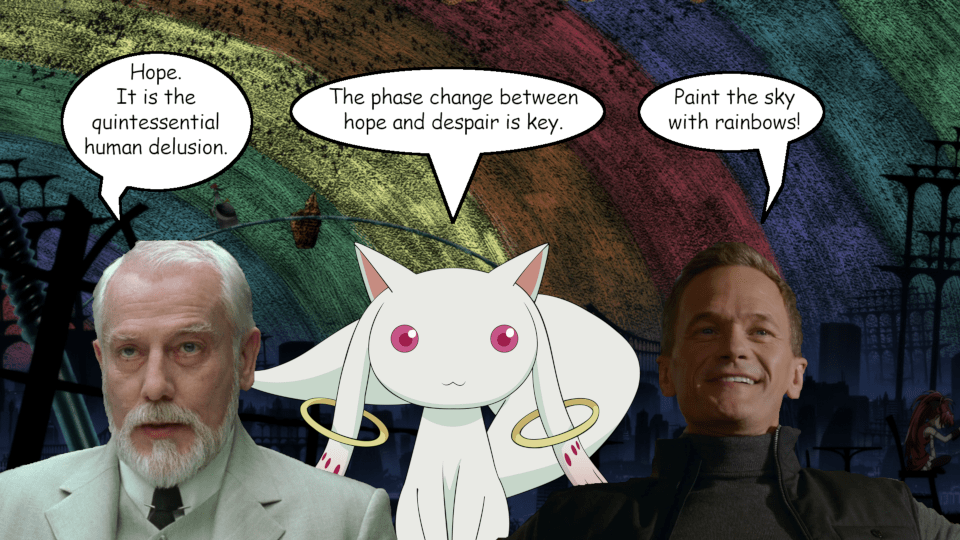
I suppose I should start with the little things I noticed.
I was watching The Matrix Resurrections with a fellow catgirl on Easter Sunday 2022. I noticed The Analyst ask Neo “Did you know that hope and despair are nearly identical in code?” This reminded me of when Homura talks about a “cycle of hope and despair” that was ended when Madoka sacrificed herself before Madoka Magica Rebellion, in which later on Kyubey mentions that “The phase change between hope and despair is key,” for gathering energy from magical girls becoming witches while Homura is becoming a witch. Which pings back to something else the Analyst says at the end of The Matrix Resurrections: “Remake [this world]. Knock yourselves out. Paint the sky with rainbows.” Which is exactly what was going on in Madoka Magica Rebellion. The sky of the false Mitakihara City was painted with rainbows before Homura remade the world after protecting Madoka who sacrificed herself protecting all magical girls from a fate of despair in Beginnings and Eternal… which… seems…
…flimsy, right?
A few lines here and there that say stuff about hope and despair and rainbows in the sky and remaking the world… that could be in any two film franchises, right? Except… RESURRECTIONS IS ALMOST AN ANAGRAM OF RECURSIONS WHICH IS EXACTLY WHAT IS GOING ON HERE??? I’m just kidding on that last bit.
Or am I…? Given the etymology of “retcon” and what’s leftover from such an anagram…
The Incubators didn’t necessarily hate the human mind like the Analyst said his predecessor, the Architect, did. However, I would say that both the Incubators and the Architect hated that they couldn’t manipulate human emotion with their supposed intellect (both express anger and arrogance at different points, signifying emotional traits that Kyubey denies having) the way they wanted to by the end of things in both of their story arcs. There’s The Matrix Comics Vol. 1 story Bits and Pieces and The Animatrix shorts The Second Renaissance Parts I & II that talk about the Synthient uprising, and how Synthients are “endowed with the very spirit of humanity.” This is what Neo is seeing after Smith (possessing Bane) blinds Neo while they are fighting aboard the Logos. That the Synthients, like humans, are beings of light. Smith, given that he is a literary stand-in for fascist ideologies, comes across as an infernal being.

Further, while the Architect never tells an outright lie, similar to the incubators, Agent Smith ALMOST ALWAYS lied in the first three films in key ways that told us A LOT about his own bigotries and insecurities and the truths he did tell ALSO told us a lot about himself (compare his monologue about humanity being a endlessly-replicating virus in the first film with what he becomes in Reloaded and Revolutions). In Resurrections after Neo gets unplugged again, Smith starts telling the truth for the purpose of gaining his own power, similar to when he was using Neo’s name in the first few minutes of Reloaded. Which ties back to The Architect scoffing, “What do you think I am? Human?” at the Oracle when she asks “What about… the ones who want out?” the end of Revolutions. The Architect was scoffing at the possibility that he wouldn’t give humans the choice to leave the matrix if they wanted to after Neo’s sacrifice when he is asked about it by the Oracle (as if to ask “Why would I lie? Am I human?”). When Smith’s objective is completed in Resurrections, we see him become the barista from earlier in the film and return to his old deceptive ways.
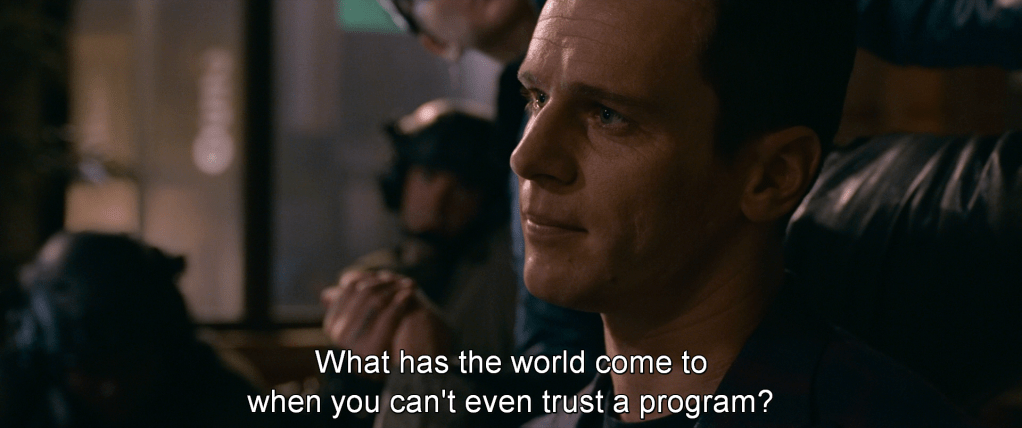
Setting Smith aside (despite being an important piece of the power dynamics in The Matrix as an agent), why am I talking about the Architect, the Incubators, and the Analyst as if they are the same kind of beings? WELL, it’s because they all harvest human energy, and it all has to do with the inherent devaluation involved in all power dynamics. Where the Architect found a way to make the matrix simply WORK (give humans “a choice, even if they are only aware of it at a near unconscious level”) that worked for the Synthients for almost 600 years (possibly, given the length of the war Zion has been facing and the length of time it took the resistance to find Neo AKA the sixth recurrence of the Prime Program), the Analyst found a way to make it work EVEN BETTER for the Synthients than the Architect did that wouldn’t require the recurrence of a Prime Program and a repeated extermination of Zion/Io. Random side note: Remember how Akemi Homura was repeating time over and over again for Kaname Madoka and how Modal Morpheus said the blue pill was “the same thing, over and over”? Anyways, there were the Incubators trying to confirm the existence of The Law of the Cycle in Rebellion for the purpose of controlling her…

In short: the Architect, the Incubators, and the Analyst are all entities that engage in the absorption of human intellectual, emotional, and physical energy; and they all engage in various recuperation tactics to redirect revolutionary energy.
Part 3B: The Matrix and Magical Girls
So, I lied. This isn’t just about The Matrix. It’s about a lot of things, kinda like The Matrix and Madoka Magica films. At the core of it all: love. These are love stories (though I’m still kind of unsettled by the standard set by Rebellion… it made me feel things, and it wouldn’t if it wasn’t good art). I guess a good place to start with the essay proper is where I initially started off with this essay series: Madoka Magica.
First, a timeline:
The Matrix – 1999
The Matrix Reloaded – 2003
The Animatrix – 2003
The Matrix Revolutions – 2003
Puella Magi Madoka Magica (the anime series) – 2011
Puella Magi Madoka Magica: The Movie (Beginnings & Eternal) – 2012
Puella Magi Madoka Magica: The Movie (Rebellion) – 2013
The Matrix Resurrections – 2021
Madoka Magica is a magical girl anime with (one could argue) elements of isekai anime (that is, anime where characters travel to another world and must learn the rules of that other world to survive). The Matrix, conversely is an isekai anime with what could be argued are elements of a magical girl anime. Both work on their own as action/sci-fi anime, but they also work very well for the kind of philosophical strip-mining that I’m doing, AND they are both meta as hell.
I feel like I shouldn’t have to point this out, but it bears repeating because some dudebros like Andy Taint like thinking the first Matrix film is for them and not an action film rooted in a rich millennia old philosophical tradition of basically asking the big questions like “How do we know what we think we know?” in the context of a sci-fi/action love story… but The Matrix as a body of work is ALSO rooted in the anime and comic books culture of the late 80s to mid 90s. We’re talking Akira, Ghost in the Shell, Armitage III AKA Armitage Poly-Matrix (emphasis mine).
Now, the meta references:
In the opening moments of Madoka Magica Beginnings, after Homura shows up and is a complete new age weirdo to Madoka, Madoka tells her friends about it. Sayaka mentions “moe” in reference to Homura’s behavior toward Madoka. Moe is an anime trope referencing enduring cuteness in an anime or manga character. Sayaka also mentions that Madoka is acting like an anime character in reference to her uncertainty about how she might know Homura (a dream Madoka had). Later, after Homura is seen trying to murder execute Kyubey in her spiffy magical girl outfit, Sayaka mentions cosplay. When Mami is giving Madoka and Sayaka a guided tour of the world of being a magical girl, Sayaka brings a baseball bat, while Madoka brings a notebook with magical girl costume ideas (which gets her laughed at, but it’s all in good fun).
In Eternal, during Homura’s recurring timelines, we see see name of the animation company (Shaft) as a weapons manufacturer where Homura arms herself to fight witches. We see this again when Homura is fighting Walpurgis and fires a bunch of rockets at the giant witch. After Madoka’s wish to become the Law of the Cycle, Junko Kaname asks Homura (the only person who has any memory of Madoka due to her status as a user of time magic) if Madoka is an anime character. So just so many references to anime/manga tropes within the films themselves.
Where The Matrix and meta references are concerned, it’s more subtle (until Resurrections, where we just get drenched in raining code with it). In the first film, this was both timely and timeless.
First off: Neo believed it was the year 1999, and it shows within the computer generated dreamworld. The Wachowskis were probably being smart and playing off of Y2K fears (fears that the whole world would come to a screeching halt at midnight on New Year’s Eve 1999 because for so much software, the “year” field had two digits rather than four). The film was written in the early 90s and released in 1999.
The way violence was talked about in The Matrix series by the runners is in very militaristic terms. It seems like the Wachowskis were being very self-aware about the fact that the Good GuysTM in the films were considered LITERAL TERRORISTS by the state within the computer-generated reality of the matrix and the directors wanted to make sure about the fact that the runners were clearly going after military targets and not civilian targets. One example of this is when the runners are hatching a plan to save Morpheus and Tank explains to Neo that “Morpheus is in a military-controlled building.”
So… if any of the yay-hoos want to claim that they were inspired by The Matrix to go on a murder spree killing civilians in cold blood, they were doing a horrible misreading of The Matrix as a text. This is made even more clear when Morpheus is giving his “Three Captains/Providence/Purpose” speech in Reloaded: “All of our lives we have fought this war. Tonight I believe we can end it… Isn’t that worth fighting for? Isn’t that worth dying for?” Remember, to the average person living out their days in a pod in the matrix: Morpheus and the runners are considered terrorists. Agent Smith mentions this to Neo when he is captured in the first film: “[Morpheus] is considered by many authorities to be the most dangerous man alive.” Consider these films came out around the same time as 9/11, and the imagery of an exploding skyscraper in relation to a group of terrorists who are (on the surface, to the viewer) “the good guys” was still used so soon after the terror attacks of September 11, 2001… is… yeah… a lot to potentially unpack there… but I’m gonna move on.
I think it is important to note that moral panics function a lot like “the matrix” as a system.

There’s a few advertisements in the sequels. One of them simply says “Steak!” with a cow’s face. In the first film, Cypher, who betrays the crew of The Nebuchadnezzar, makes the point that the steak he’s betraying them for doesn’t exist. In Reloaded, The Merovingian (who I will hereafter be referring to derisively as “Merv” in honor of all French philosophers) makes a big show of describing all the food and drink around them as as “contrivance, for the sake of appearance.” In Revolutions, there’s some ads for a certain real-life drink. Prior that, there’s an ad for an in-universe cereal (Tastee Wheet) and the in-universe power company (City Power). All of this reminding the viewers: advertisers are fake. Corporations are fake. The False Mitakihara City Matrix isn’t real. And in the case of Rebellion, we can glean that sometimes we create our own matrix and get stuck within it. This is a criticism General ‘Be makes while giving Neo a guided tour of Io in Resurrections.
I didn’t initially want to talk about vore, but I guess I can’t avoid it since I am talking about the Wachowskis and anime. So, the red goo in the pods is the recycled humans used to feed other humans used to power the Synthient cities. That’s pretty straightforward…
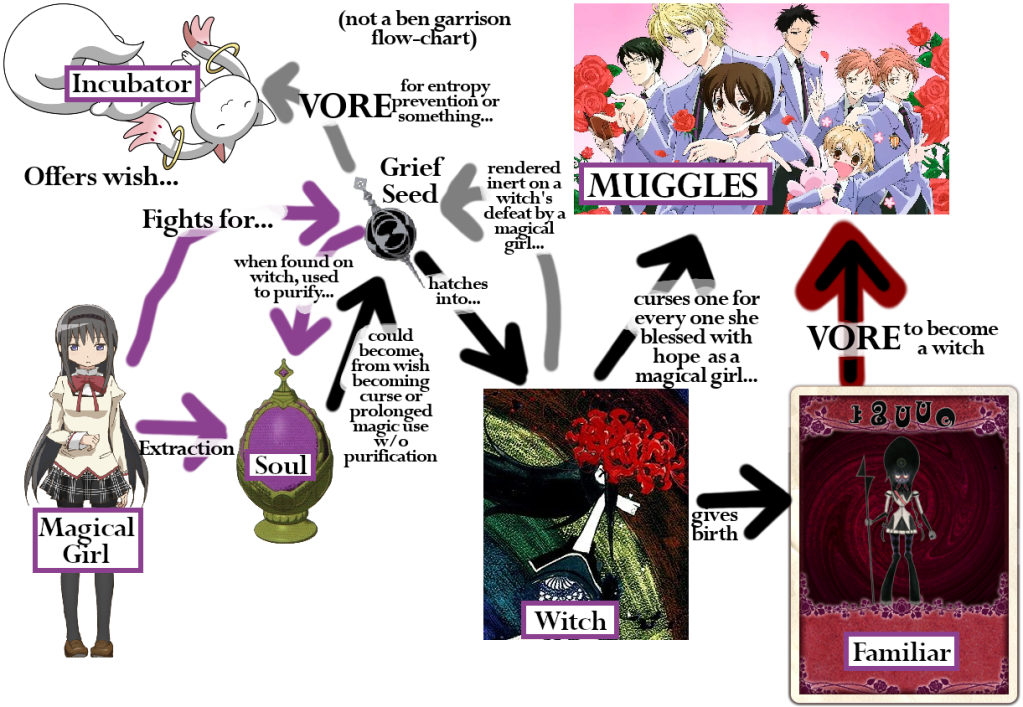
Then there’s Kyubey. Kyubey grants wishes. The wish causes an alteration in reality. The process of granting the wish involves ripping the soul of an adolescent girl out of her body to create the soul gem, which is what allows the use of magic and basically makes one immortal and invincible so long as there are enough grief seeds to spare. When the wish becomes a curse, or a soul gem becomes too corrupted from continuous magic use because no inert grief seeds are available, the soul gem becomes a grief seed, and a magical girl becomes a witch. Sometimes, witches give birth to familiars. This is where the vore comes in. When Sayaka and Madoka go out on their first hunt together after Sayaka makes her wish, she finds a familiars’ labyrinth. However, Kyoko steps in to let the familiar escape, explaining that familiars need to eat four or five humans to become a full-grown witch.
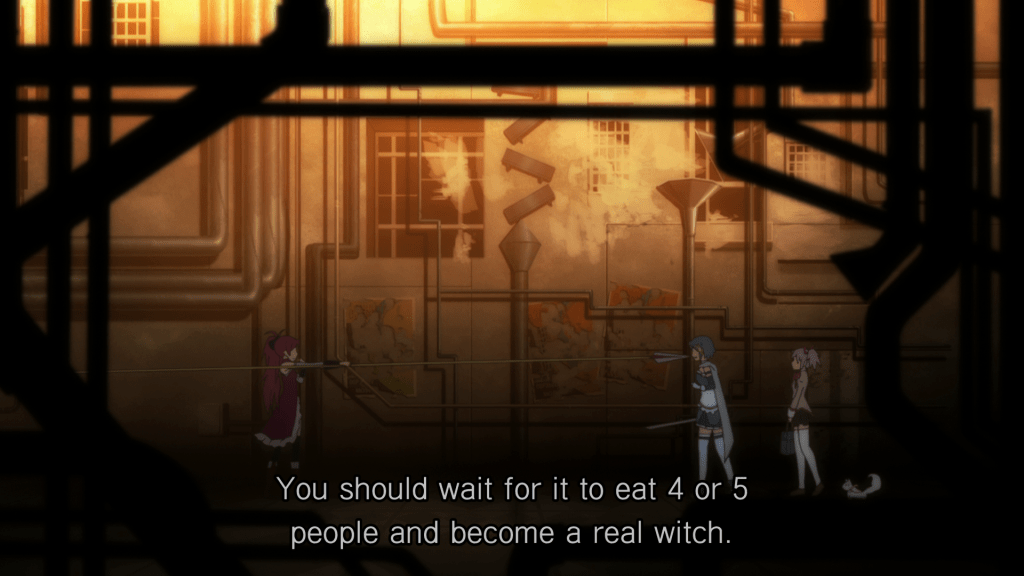
The witches that magical girls defeat, the grief seeds those magical girls leave behind that magical girls purify their soul gems with – are the true objective of the Incubators and allow magical girls to remain magical girls rather than becoming witches. Though, the only ones who know this are Kyubey and Homura at the start of the main timeline (the start of the first episode of the OG anime/ the movie adaptations starting with Beginnings), and we learn from Homura at the beginning of Eternal that no one has ever believed her about soul gems and witches.
Explaining the vore more simply:
- Synthients (machines)
- Powered by humans in a symbiotic relationship.
- Feed humans to themselves intravenously to power Synthient cities.
- For the Incubators, I have created a handy-dandy flow-chart!
˅˅˅˅˅spoiler˅˅˅˅˅
Kyubey and the Incubators (and possibly Joanne Karen Galbraith) eat people.
˄˄˄˄˄spoiler˄˄˄˄˄
As far as more “superficial” connections go…
~:aesthetics & vibes:~
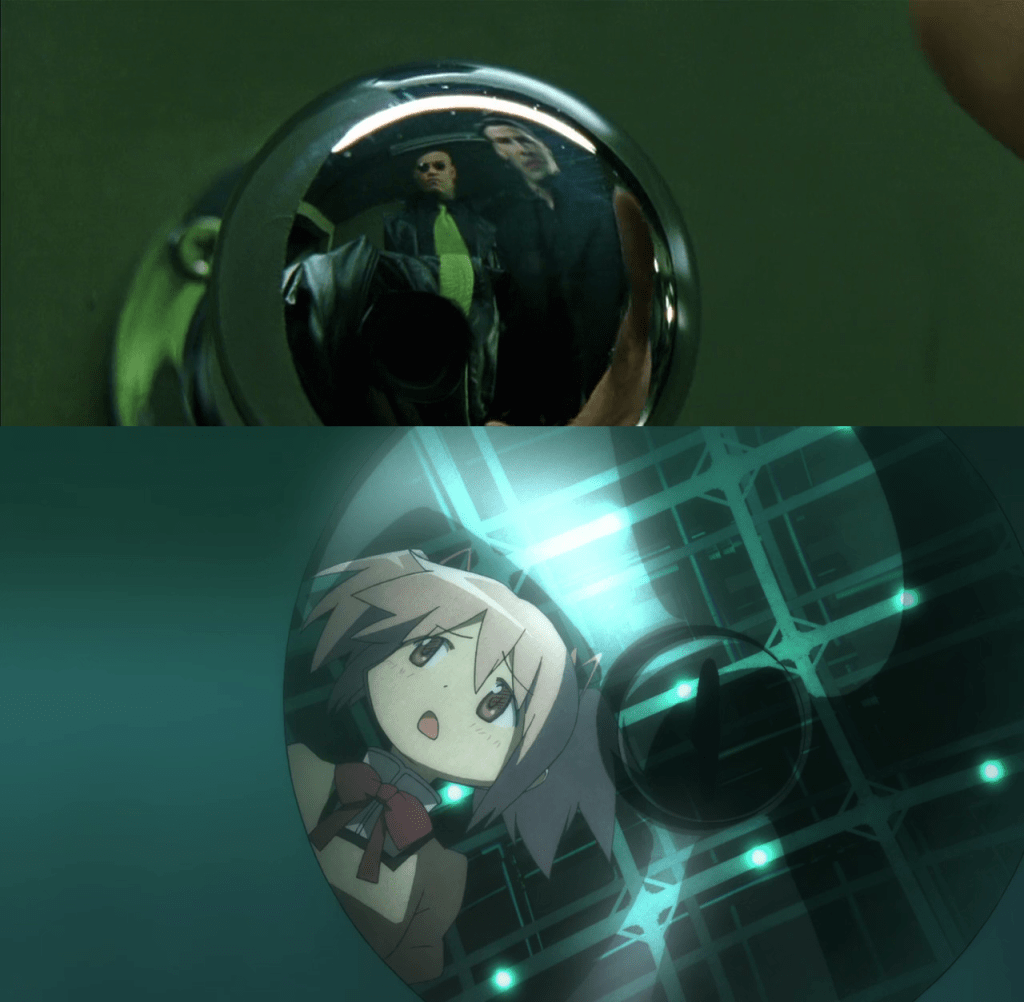
First, LOOK AT THESE DOORKNOBS! JUST… LOOK AT THEM!!! Both of them at about an hour into the first films in their respective trilogies. Both of them “blink and you’ll miss it” moments.
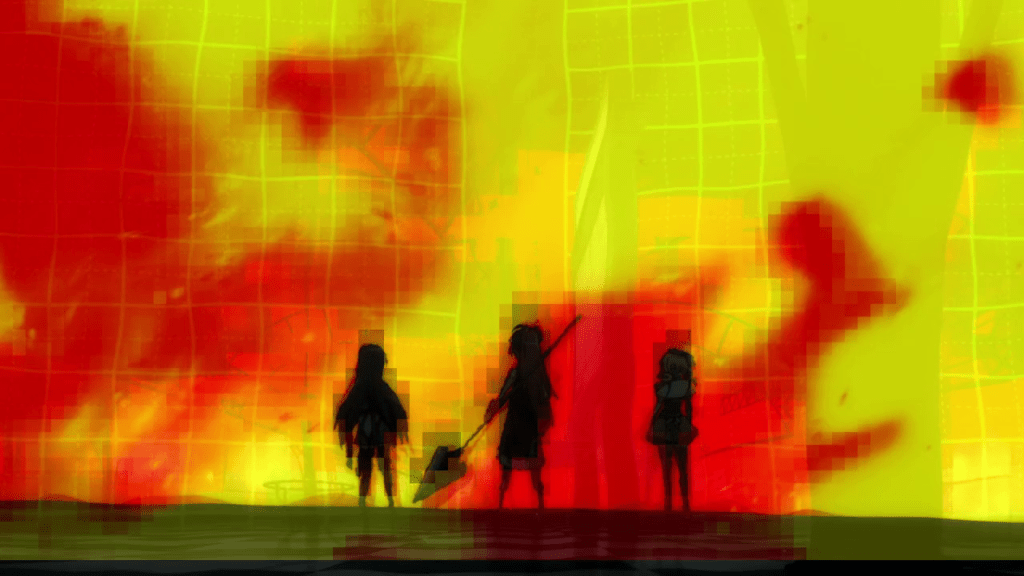
When the universe changes after Madoka makes her wish, for a brief second after a bunch of wraiths get burned away and we see Homura, Kyoko, and Mami standing alone, and there’s this green grid and pixelized effect in the frame for a split second:

Now, we move on to Rebellion.
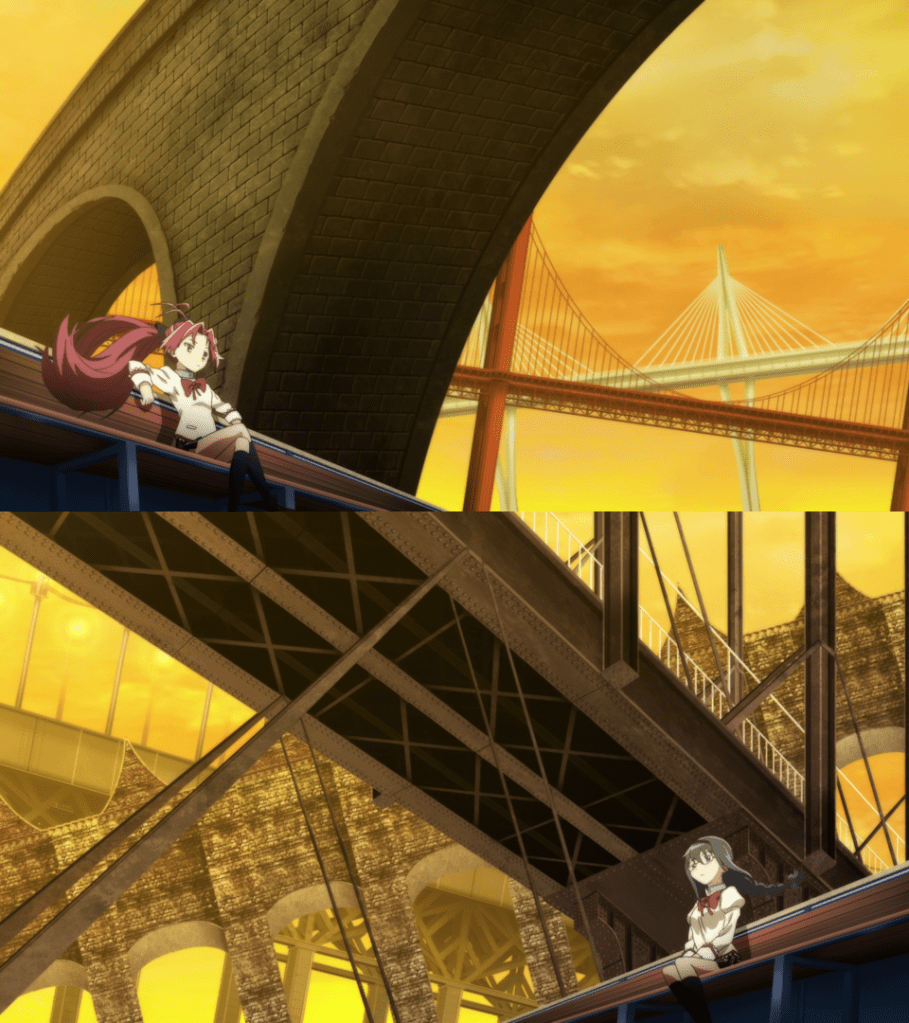
So, there’s the frames above that was in Part 2 of this series. These are all different iconic bridges from different places around the globe. Now, The Matrix Resurrections (2021) was obviously set in San Francisco for most of the film, and Tokyo and France for other parts of it. However, the original trilogy (1999 and 2003), was just set in “the city” (I’m not digging into TMxO lore). There’s references to streets in Los Angeles and Chicago that I’m aware of off the top of my head. And the skyline was amalgamated from different parts of different major cities across the globe (my citation on this is The Matrix Revisited, the “making of” documentary of the original Matrix film). This amalgamation of cityscapes may be what the shot above is a reference to with regard to the fact that they are in a False Mitakihara. HOWEVER, as I was researching, I found out the rabbit hole of architecture of Mitakihara City goes A LOT deeper, and it’s interesting to note the near complete lack of… how shall we say… “accurate” United States representation aside from the Golden Gate Bridge we see above. But that isn’t all, because what discussion of the Matrix would be complete without…
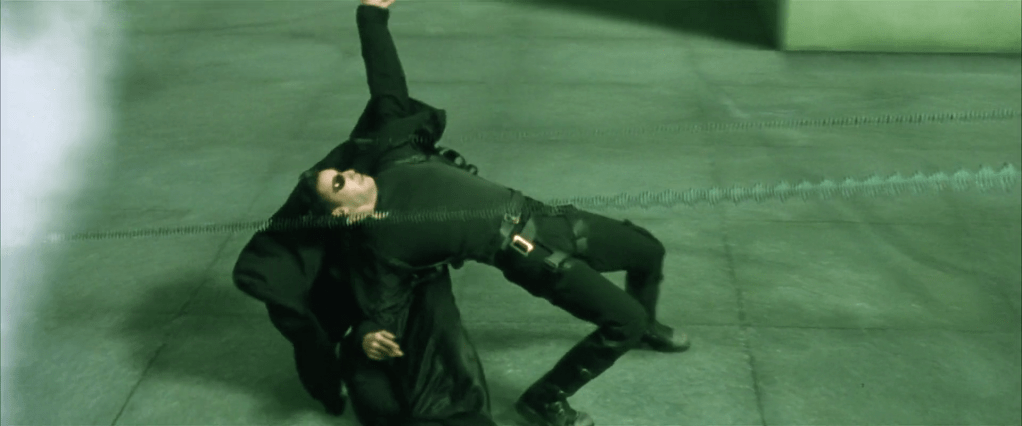
…bullet time. It was a big deal when it happened. It blew people’s minds. It blew my mind. It was awesome. Time warped. Space bent. Matrix people went all flowy. Every action movie did this to infinity. It’s been discussed to death.
BUT THEN…

The above frames ping back to these two dudes…
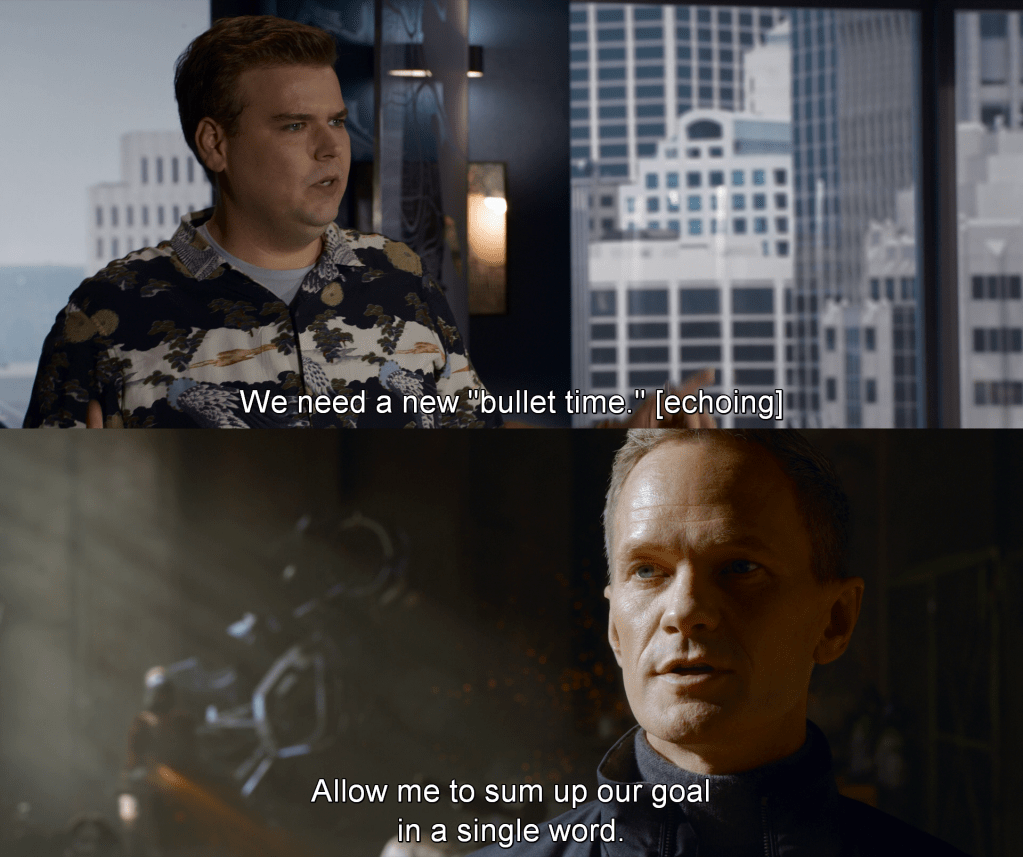
It is WILD to me that Madoka Magica, for all the other similarities to The Matrix philosophically, they got this time aspect in. Even going so far as to having Sayaka hear the click of Homura’s shield before she uses time magic and having Sayaka stop it with her sword in Rebellion! It is a fantastic scene with how it plays out. Even further, they had BOTH Homura continually sacrificing herself for Madoka and then Madoka sacrificing herself ad infinitum similar to how Trinity and Neo continually took risks for each other and the salvation of Zion in The Matrix. The major inversion here, is that Homura relied on her time magic (bullet time, in a sense) and was a big part of how awakened Madoka to her potential as the Law of the Cycle (sacrificium ad infinitum), while Neo engaged in sacrificium ad infinitum in The Matrix while relying on his own sense of time and space while being supported by Trinity.

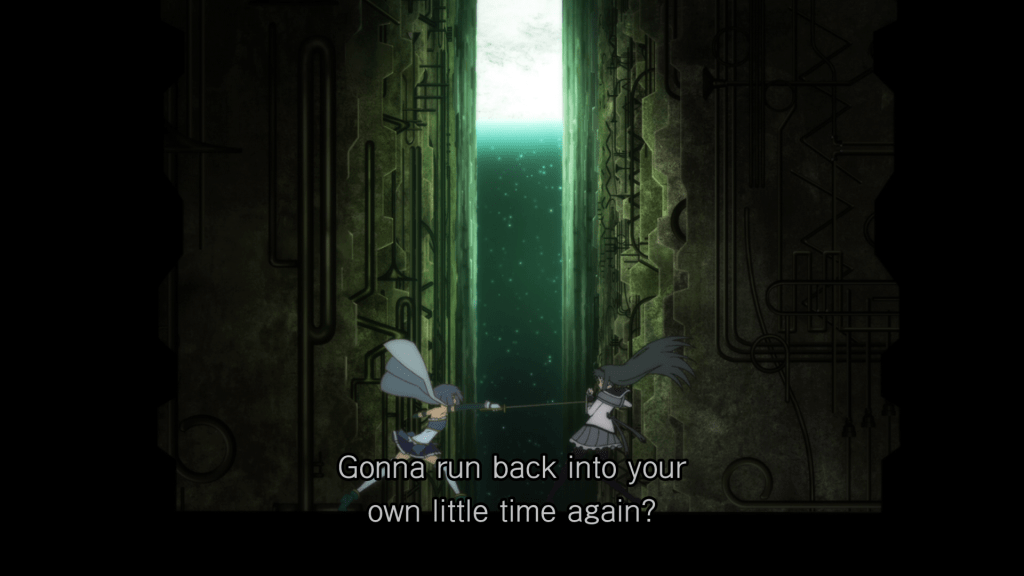
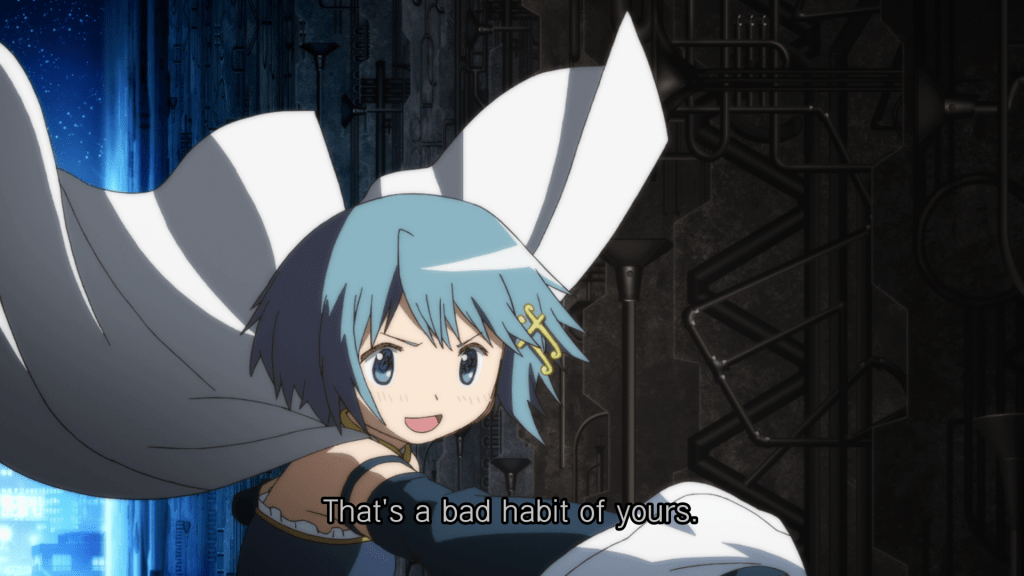
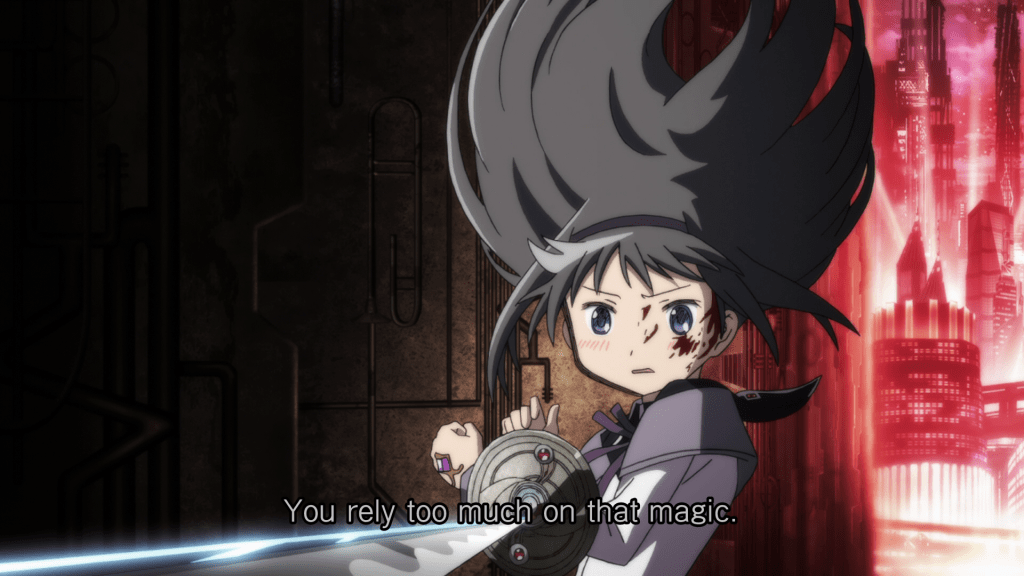
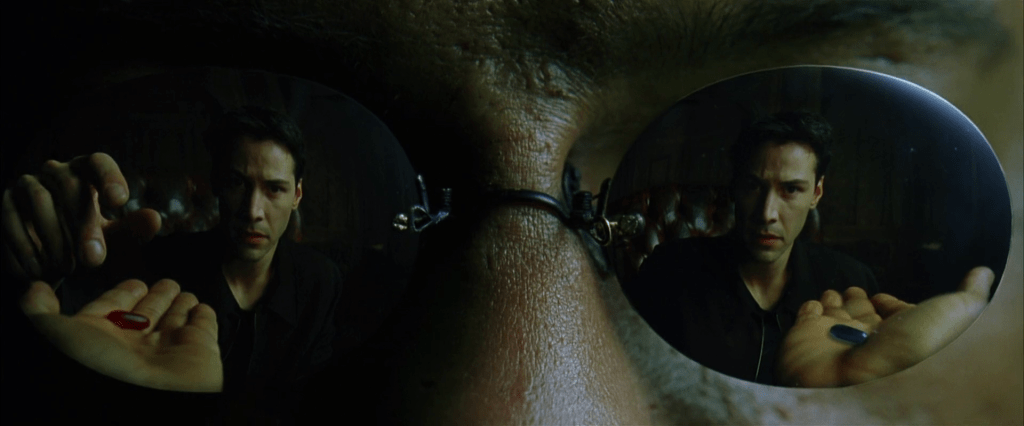
There is an alternative explanation for the colors we see above, though.
From a purely aesthetic standpoint, it makes sense for Sayaka to have a blue background. In a manner of speaking, it also makes sense for Homura to have a red background. For Sayaka, she’s the Sailor Mercury water motif lady of the crew. Where Ami Mizuno was studious and uncertain about her destiny as a Sailor Scout, the inversion here is that Sayaka was VERY excited to be a magical girl at first, hated homework, and fell asleep in class.
For Homura on the other hand, there’s also other plausible explanations. She’s got blood on her face, foreshadowing the reveal of the ribbon in her hair on the outside world. There’s the foreshadowing for her demon form. There’s the green moon on one end and (so far as I can tell) nothing really on the other. The significance of the moon here has to do with the color theory of the OG Matrix trilogy: green was for the world of the mind. In this case, the False Mitakihara is all contained within Homura’s soul gem.
Interestingly (I may have mentioned this previously in Part 2), after Homura makes her choice, the four pathways become three, which is some interesting imagery about how when we make choices, we are exercising freedom, but we sometimes end up with less freedom than we had before (most United States-ans and neo-liberals more broadly have poor conceptualizations about what ideas like “freedom” and “violence” look like in practice).
Sayaka is asking Homura if she’s sure she wants to press on to find the truth and asking what she’s going to do about what she finds. And then there’s Homura. Dead set on finding out the truth. Dead set on her path. Pure. Fucking. Red-pill. This scene reminds me of the opening dialogue between (then Captain Nio)’Be and Ghost in the opening cinematic of Enter the Matrix: “You know me, Captain. It’s not a choice. It’s a way of life.”
Part 3C: Resurrecting and Rebelling
Like The Matrix Resurrections, Madoka Magica Rebellion has a lot to do with memory and trauma. Rebellion takes place in a false Mitakihara, with everyone’s memories re-written, including Homura’s, except those of Kyubey, Sayaka Miki, and Charlotte (who is called Bebe throughout the film while acting like a magical girl mascot). In Resurrections, we see something similar: both Neo and Trinity are have new memories forced on them (something similar is attempted on the runner Dan Davis by agents in The Animatrix short World Record to similar results as Neo and Trinity in Resurrections), and it seems as though in the case of all the characters who have experienced memory re-writes mentioned in this paragraph, they can have have their memories uncovered with the right kinds of questions or pokes or prods.
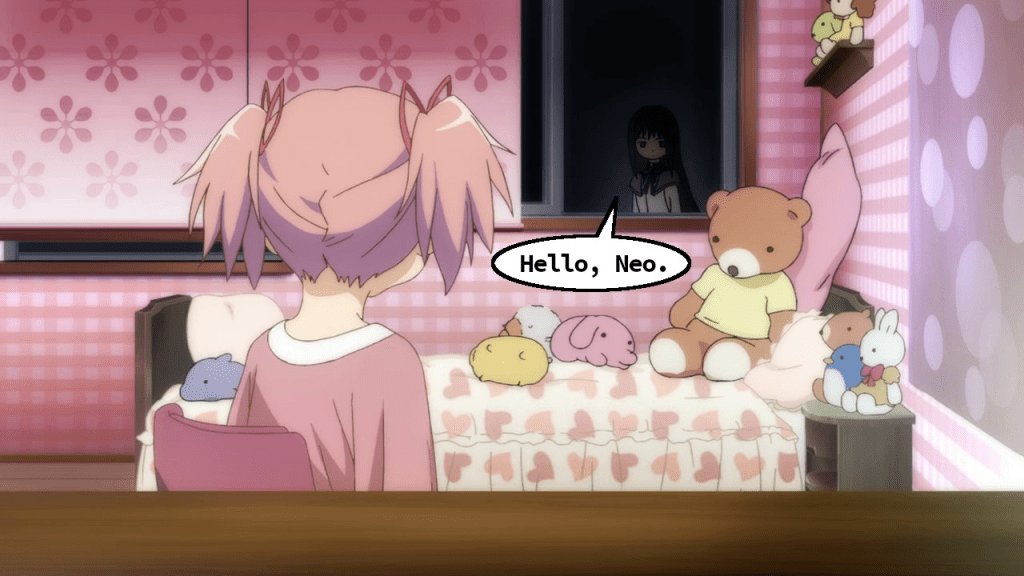
Neo and Trinity, similar to Homura, Kyoko, and Mami, have flashes of their memories return over the course of the Resurrections and Rebellion respectively. However, it takes help from those outside the False Mitakihara “matrix”to fully peel back the veil. For Neo, and eventually Trinity, that help comes in the form of Bugs and the crew of the Mnemosyne (a ship name with the same function as the Neb: Morpheus and his crew were dreamers; Bugs and her crew, along with the audience, were remembering). For everyone trapped in Homulilly’s labyrinth, that help was supposed to come in the form of Madoka Kaname AKA The Law of the Cycle. However, Homura’s memory re-writes got in the way, and the shenanigans of Rebellion played out from there. I’ve written about the Synthients and memory manipulation and how that is the sci-fi explanation and that’s… kinda… whatever. I’m writing about THE MATRIX. I have to get all heady and philosophical.
At the end of the day: one big lesson I take away from these stories is that none of us can really do anything by ourselves. We are interdependent. In Viral Justice by Ruha Benjamin, she quoted Bayard Rustin as saying “We are all one, and if we don’t know it, we will learn it the hard way.” Media like The Matrix (AS A BODY OF WORK) and Madoka Magica is the easy way for a lot of people to begin to learn this concept, but the culture that has to exist for these kinds of stories to be relevant has to be dire. That culture is one that works HARD to make us forget our “non-profitable” connections to others, even ourselves. That culture is one that makes forgetting our connections preferable on the surface to doing the messy, necessary work of relationship and community seemingly undesirable in order to sustain itself.
“That culture” is what bell hooks described in All About Love – New Visions as “capitalist imperialist white supremacist patriarchy.” The world that has been pulled over our eyes that sustains itself through unchecked violence against black bodies, trans bodies, disabled bodies, and for those of us who survive in body, our mental and emotional states aren’t just magically A-Okay afterwards… Ruja Benjamin also discusses “weathering” in Viral Justice and how, essentially, when it comes to trauma…
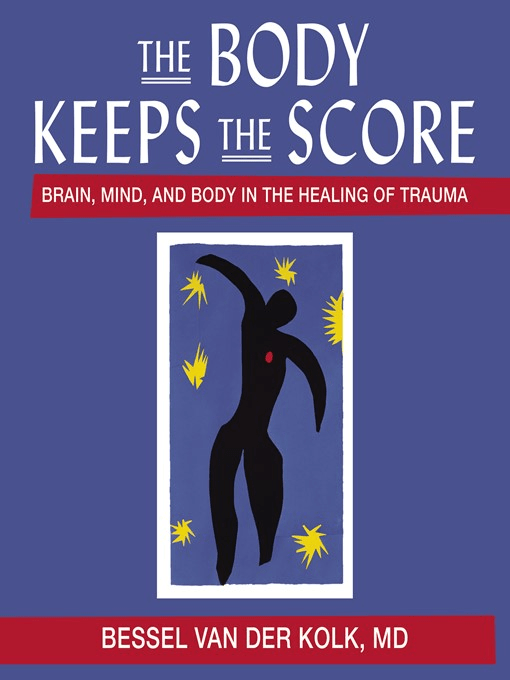
A combination of the The Body Keeps The Score by Bessel van der Kolk, MD; Stone Butch Blues by Leslie Feinberg; and some posts from an old blog I used to run (when I was a naughty child who wrote naughty things) unearthed a lot of memories that part of me wanted to stay buried. However, the wiser part of me knows that having them more on the surface to unpack will help me move forward and live more in the present. I will write about one of those memories, and say: as a member of BOTH major categories of people Dr. van der Kolk writes about (survivors of sexual assault and combat veterans), it is far more horrifying being a survivor of sexual assault than it is being a US military veteran. The former is a victim. The latter is very specifically trained to inflict violence.
The culture of the US is one of violence, rooted in a long history of violence dating back centuries before the US was even formed. It is not glorious. It is brutal and awful. Love and tenderness are glorious. Vulnerability and kindness are glorious. To be clear: I did not join the US Army by choice. It was forced on me as a means of conversion torture by my family of origin. I was as politically aware as I could be at the time that the recruiter called our apartment, I was vociferously anti-war, and my father new it.
Without further adieu, a war story:
~{the catfish aside}~
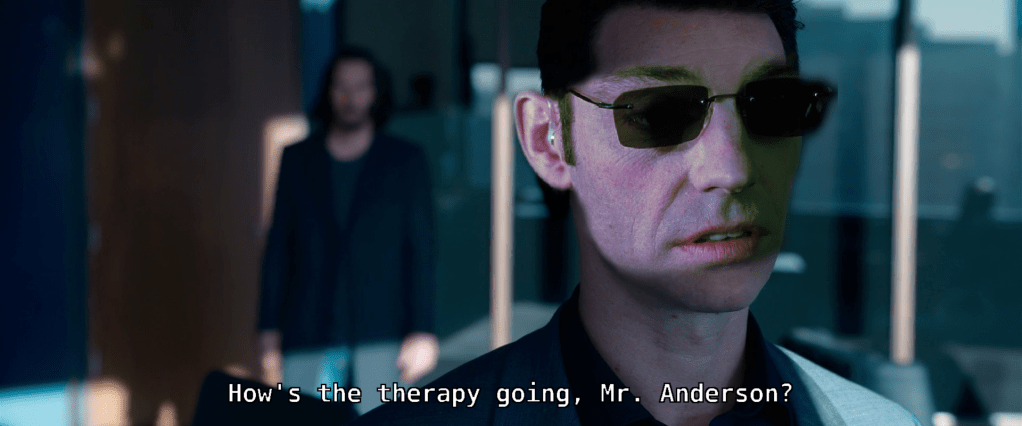
In November 2021, I was frying catfish. Fish fry, cayenne pepper, sage, salt, black pepper, Old Bay. I had just finished frying the fish when I started to sauté some broccoli for a side and heat some microwave rice (I was putting my effort into the fish and they didn’t have a steamer and I always fuck up rice when I try to cook it so don’t make fun of me!!!). I moved the oil to a different burner. I placed the skillet in which I was going to be sautéing the broccoli on the burner that was already hot. For some reason, I had turned the burner off for the short amount of time between when the oil I cooked the fish in was going to be moved and when I had things prepped for the broccoli? Anyways, I turned the burner back on. It smelled strange, but I couldn’t place why. I just let it keep going for the time being. I noticed the broccoli skillet wasn’t getting warm. There was a loud pop.
Suddenly, I was on a FOB in Iraq. Insurgents were walking mortars in on us after our convoy had just been hit by an IED. No one was injured, but a brake line got cut, so they were dragging their trailer for the last 2 miles of the convoy. The characteristic stench of burnt rubber dragged through the air with us. I remember the first thing the Platoon Officer asked was “Were you wearing earplugs?” to the soldiers whose truck got hit. Wait, wasn’t I cooking catfish?
OH NO WHY IS THE OIL POT SMOKING??? WHY IS THE BROCCOLI SKILLET STILL COLD??? The microwave was beeping at me, too. What I had realized was that, despite the horrible stuff that happened to me in Iraq: this specific experience was something my brain didn’t register as traumatic. It simply registered as “Typical Job Hazard. Disregard.” I went in expecting to have people trying to shoot me and blow me up just like I expected drill instructors to yell at me at basic training.
There’s a lot I remember very vividly about my time in Iraq, but there are a few specific memories I buried. This was one of them that got buried, strangely enough. The strange alchemy of burnt cooking oil, the sound of the rice bags popping in the microwave and the stovetop vent, just put me in two places and times at once. I had to sort out which one was real and which wasn’t. Thankfully, I didn’t decide the mortars were real in that moment, though they were at one time in my life.
The interesting thing is: I can’t take the mortar attacks, IEDs, or small arms fire from any of the Iraqi insurgents toward me or any convoys I was a part of personally. I’m not trying to sound like some Annie Rambo or G.I. Jane, but I instinctually processed my own possible death, disability, or dismemberment before I went over there. Looking back now with an understanding of the DABDA grieving process (Denial, Anger, Bargaining, Depression, and Acceptance), I know exactly when I was experiencing which emotion with regard to what I was experiencing that emotion about.
When my “fellow” soldiers were putting their hands on me, however: that was personal. And I didn’t do DABDA before hand, because I didn’t expect it beforehand. Also, because I wasn’t “socialized” feminine, I didn’t have the supports that cis women have built together for that kind of stuff. I am grateful to say that I do now.
Back to the combat aspect of things, however, when I got back, the US was referred to as “the real world” by members of my extended family. As if to say any possible Iraqis caught in my crosshairs weren’t real people living in the real world, and therefore did not deserve my consideration or the consideration of the US-“Freedom”-Making machine.
~:resurrecting more, rebelling more:~
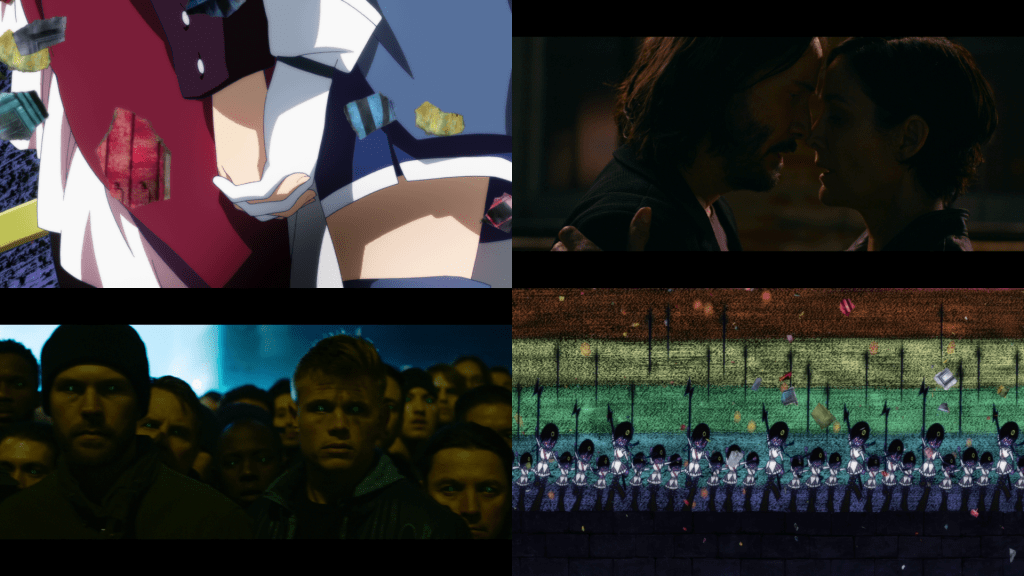
With everything seemingly coming at justice workers from all sides, it is easy to be overcome by despair. When even our best intentions are hijacked by corporations trying to make a buck instead of making a change, how do we keep ourselves from succumbing to the seemingly overwhelming call of “the void”? One big way is that we simply have to remember what’s important: each other.
In the Matrix films, this is shown in Neo’s character arc in the following ways:
- Neo couldn’t have awakened to his potential without help from the runners and by crossing lines with “the enemy” to work alongside folks like the Oracle, Seraph, and the Keymaker.
- Neo couldn’t have flown to the Synthient city at the end of Revolutions if ‘Be hadn’t offered her ship. In Resurrections, again, Neo couldn’t have gotten out of his imprisonment without the help of others.
- Even with Modal Morpheus, Neo still needed the help of the crew of the Mnemosyne acting “in direct violation of” General ‘Be’s protocols. In fact, M. Morpheus brings this up to Neo, saying that Neo programmed him “as an algorithmic reflection of two forces that helped” Neo become the person that he was by the end of Revolutions (then let’s all make a joke about me not remembering the line after I remembered the concept of it).
MEANWHILE, in Madoka Magica the beginning status quo is “Witches are the enemy of magical girls.” This is what Madoka, Mami, and Homura assume through Homura’s first two timelines. That view may change into the Incubators becoming an essentially immortal (unkillable) viral enemy as the viewer learns:
- Magical girls become witches when hope turns to despair and wishes become curses (the first time the viewer sees this is at the end of Beginnings when Sayaka’s soul gem breaks open into a Grief Seed).
- Kyubey/the Incubators are intergalactic space aliens bent on maintaining the current universe as is, and use the cycle of hope and despair (emotional energy) of adolescent girls circumvent the laws of thermodynamics.
The status quo doesn’t change until Madoka makes her wish and becomes the Law of the Cycle. However, she doesn’t do it alone.
- Madoka watches Mami die at the hands of a witch. This heavily traumatizes her.
- The last thing Madoka hears from Sayaka, her best friend is, essentially “I’m suffering because you’re a coward!”
- Madoka is prevented from making a wish to save Sayaka by Homura near the end of Beginnings.
- In Eternal, she is almost crushed by the witch that used to be Sayaka, and she is put in that position by Kyoko who is trying to use Madoka’s connection to Sayaka to save Sayaka from being a witch.
- Finally, after learning the history of the Incubators and magical girls from Kyubey as well as of Homura’s past attempts at saving her, Madoka Kaname makes her wish to become the Law of the Cycle.
In Rebellion, Homura becomes a witch intentionally to force a fight with the rest of the Magical girls. However, rather than getting the death that she sought in order to protect Madoka from the Incubators, she was saved by Madoka and the rest of the crew. Due to the way Homulilly’s memory re-writes worked: Madoka, Sayaka, and Bebe (because of their quantum characteristics) all had a choice on whether or not to have their memories altered when they entered the False Mitakihara. Madoka did, while Sayaka and Bebe did not. In short, Homura needed help not just from outside her False Mitakihara, she needed help from beyond her current spacetime.
~{inevitabilis}~
Unfortunately recuperation by the ruling class happens. That’s what the Architect’s monologue was about at the end of Reloaded, that’s what the Incubators were trying to accomplish in the False Mitakihara in Rebellion, and that’s what the Analyst’s monologue was about in Resurrections. The ruling class has become exceedingly efficient at it. It could even be argued that stories like these are a form of recuperation. An emotional or intellectual processing of radical revolutionary energies rather than acting on them. What I will say is: these stories have informed and inspired my life for the better. I’m glad they are there. They’ve helped me in my own “mahou shoujo henshin” (magical girl transformation) as I engage with the healing, transformative, life-giving power of art in my own life.
Anyways, go watch Sailor Moon instead of this heady philosophical depressing shit all the time, OR IN THE NAME OF THE MOON I’LL PUNISH YOU!

 Our Lady of the Perpetual Metamagic