

Hello, there.
First and foremost, if you ended up here from a search engine, welcome! No LLMs were harmed in the creation of anything on my website (including this blog post).
My goal in writing this is to de-mistify guitar wiring while wiring a sweet guitar. Think of this as me using this as an elaborate “rubber ducky” strategy which you might also benefit from. I will be mentioning brand names. I won’t link them unless I’m getting paid.
In this post, I am covering my assumptions of you and reccomendations, the first ground wire, and 4-lead humbucker pickup wire orientation.
Here are my assumptions of you before starting this guide:
- You know how to solder.
- You know at least as much about electronics as I do (not much, but enough).
- If 1 & 2 aren’t true, you’re just fascinated by esoteric knowledge (which is kinda sexy, ngl, but application is sexier).
- If 1 & 2 are true: 4-wire humbucker or death.
Recommendations:
- As with all things, know yourself and know your equipment (I’ll recompile all the data later and provide a list of equipment recommendations).
- If you aren’t certain, look it up from a credible source.
- Remember that the struggle to create something wonderful will make the victory of success more sweet.
- Make a plan and change it if necessary.
- Remember that I am human and am open to being wrong.
Let’s start with the bridge, because the ground is always a good place to start.
Your bridge needs a ground wire. It will look something like Fig 1 below.
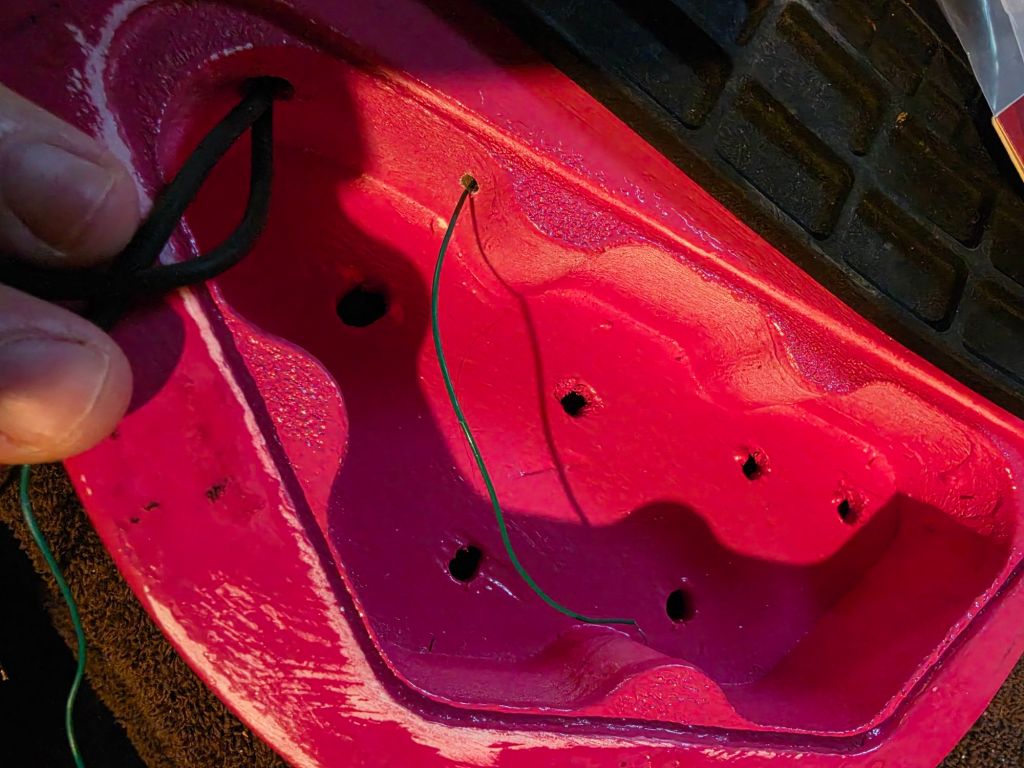
If there is not a wire connected to the bridge as a ground, the guitar will produce no sound when it is plugged in. It has to do with the electric current. It is a good idea to remember every time you plug in an electric guitar, you become part of a current as a ground wire. That’s wire the guitar stops buzzing when you put your fingers on the strings. Bloodrocuted.
Next, we’ll move on to the pickups.
Ensure that your pickups are installed properly into the body of the guitar, and that you know which shielded 4-lead cable goes to which pickup (neck or bridge). This is easier with a front-facing pickguard. Without a pick-guard style electronic set-up, the wiring is going through the body of the guitar, making it more difficult to keep track of what is what. Painters tape with a marking for which is neck or bridge helps.
Look up the manufacturers color codes for your pickups, and make a plan based on those. Your north coil end and south coil end should be soldered together and sealed with electrical tape or heat shrinking wrap unless you’re doing silly wiring mods like a nerd (like me). For most pickups, the north coil end and south coil end are red and white, while green is connected to the ground wire and black goes to the output.
My brand of pickups are like this:

Next, I’ll cover potentiometer basics, the 3-way toggle switch, and running the first test. Happy tone-chasing!

